Can Entergy Serve the Next Gigawatt?
Why Entergy is one of the few utilities able to build firm power at AI scale, what customers must fund, and how its regulated model compares with merchant ERCOT.
For hyperscalers · For infra funds · For developers · entergy · miso · louisiana · utility · large-load · firm-power
Kris Narayanan · Tafel Power · July 19, 2026 · 8 min read
Entergy is one of the few US utilities able to build firm generation at data-center scale. Its advantage is not just access to Gulf gas. It also operates in states where regulators are willing to approve large, customer-backed generation projects. This brief explains why Entergy can build, how much capacity may actually be available, and what a new customer would have to fund.
Why Entergy and not most utilities
Four things have to line up, and they rarely do together.
First, the utility has to own generation. In much of ERCOT and the restructured Eastern markets, the regulated wires utility cannot put new generation in its rate base. Firm capacity there comes from municipal or cooperative utilities, competitive generators, or bilateral deals. It does not come from your wires company. That takes much of the map off the table.
Second, and this is the binding constraint, a commission has to approve a large gas build. This is where the regulated utilities split apart. Louisiana did more than approve Entergy's gas. In April 2026 it fast-tracked review of Meta's request for seven new plants, more than 5 GW for one data center. Georgia is doing the same. In December 2025 it certified about 10 GW of new generation for Georgia Power, not all of it gas, with roughly 80 percent to serve data centers.
Virginia has moved more slowly and faced greater regulatory opposition. Dominion has far more data-center demand than Entergy. Data centers accounted for about 28 percent of Virginia Power's electricity sales in 2025. But the state's Clean Economy Act has kept its gas build well behind Louisiana's. Its one approved new gas plant is a roughly 1 GW Chesterfield peaker. That plant cleared only as a contested reliability exception. It was suspended for reconsideration, then reinstated, and has since been appealed. A newly proposed 3 GW Cumberland plant is still just an announcement.
Third, the gas has to be cheap and deliverable. Entergy sits on the Gulf, next to Haynesville and Permian supply. The region already has extensive gas pipeline infrastructure, although individual projects may still require upgrades. Utilities farther from the Gulf pay more for gas and wait longer for pipelines and permits.
Fourth, the load has to land in your footprint, and the utility needs the financial capacity to build. Entergy has the cheap land, water, and tax terms that drew the hyperscalers in. Its pipeline runs to 7 to 12 GW of possible new data-center load, backed by a $67 billion capital plan.
Only a small group of utilities passes all four tests: Entergy, Georgia Power, and a few others. The scarce ingredient is not gas or demand. It is a regulator willing to let a utility rate-base generation backed by long-term large-load contracts. Entergy has that, which is much of why the deals are here.
A growing share of the build is already claimed
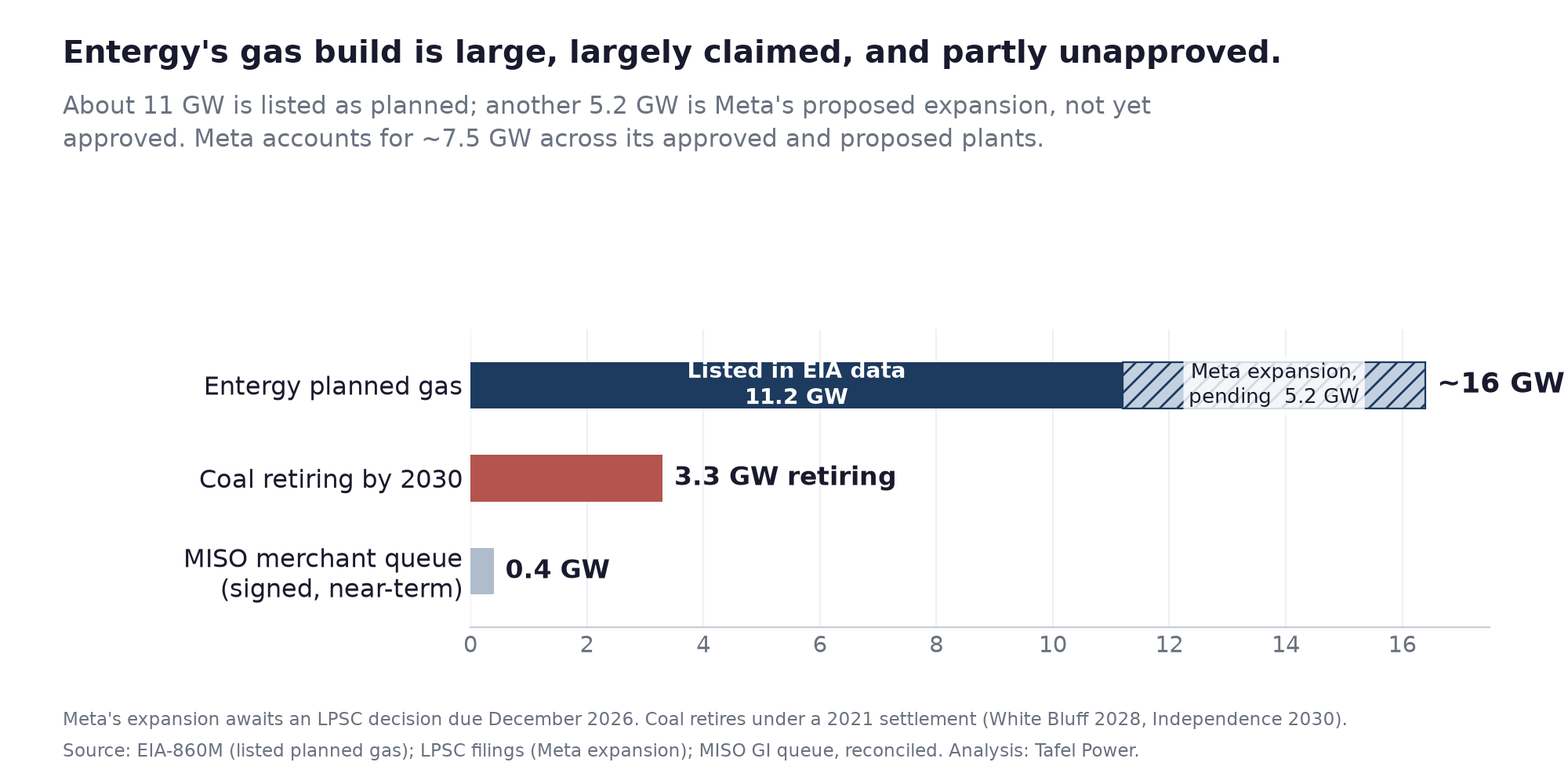
Being able to build is not the same as having capacity to spare. The federal inventory shows about 11 GW of planned Entergy gas. That number predates Meta's expansion. In March 2026 Entergy filed for seven more plants, over 5.2 GW, on top of the three approved in 2025. Meta bears the incremental costs under its service agreement. If the commission approves them, that is ten plants and about 7.5 GW tied to Meta. They span its original Richland Parish project and the adjacent Project Evest. Planned gas would then climb toward 16 GW, and Meta alone would account for nearly half. The commission fast-tracked the filing in April 2026 for a December 2026 decision, so the seven plants are not yet approved.
The remaining capacity should not be assumed to be available. About 3.3 GW of Arkansas coal retires by 2030. White Bluff closes in 2028 and Independence in 2030. Some of the new gas simply replaces it. Other named customers are also triggering dedicated resource additions. A $4 billion Google campus in West Memphis is bringing a new 600 MW solar plant and 350 MW of storage, not gas. It follows the same build-for-one-customer pattern, with Google covering the cost. Between coal retirements and named loads, little should be treated as uncommitted. The record does not fix the exact amount. The screened merchant alternative is only 0.4 GW, the point an earlier Brief already made. And the existing 17.5 GW gas fleet is not spare; it is committed to serving native load.
Why the customer bears the cost
Assigning incremental costs to the customer helps secure regulatory approval while limiting risk to existing ratepayers and Entergy's balance sheet. Entergy's June 2026 plan calls for about $67 billion of capital through 2030, supported by about $7 billion of new equity. Operating cash flow and utility debt cover most of the rest. Large-customer agreements push the added cost onto the customers that create it. That lowers Entergy's exposure. On that base the company guides earnings growth above 8 percent a year. The data-center boom is a rate-base engine for Entergy. Having Meta pay for its own load is designed to limit cost shifting to other ratepayers as the plan grows.
That protection is contested. Meta’s Richland Parish project is financed through a Blue Owl Capital joint venture that consumer groups say could let Meta exit after about four years, leaving ratepayers exposed to the new gas plants. The Louisiana commission declined to open an investigation in February 2026, and in June 2026 Governor Landry signed a ratepayer-protection order for large loads. Assigning the cost lowers the risk to other ratepayers. It does not settle the question.
What it takes to be the next gigawatt
For a new load, that pattern is the entry path. The visible path looks like the Meta model:
- Dedicated generation you pay for, through a negotiated agreement, minimum payments, direct contributions, or some mix.
- An in-service date around 2028 or later, given combined-cycle build times.
- Terms set through a negotiated customer agreement under Louisiana's evolving large-load framework.
The commission has a fast-track process for data-center projects. It shortens the permitting clock, not the building one.
How Entergy compares to merchant ERCOT
If the regulated path does not fit, the alternative is merchant ERCOT. They are two different deals.
| Entergy (regulated Gulf) | ERCOT (merchant) | |
|---|---|---|
| What you get | Rate-based, dispatchable capacity at scale, from a utility counterparty | A bilateral offtake, often faster to contract |
| Screened candidate set | 11.2 GW listed as planned, plus 5.2 GW proposed for Meta. Much is tied to named loads or retirements. | 8.8 GW in Tafel Power's screened signed, near-term merchant set. |
| What you fund | Incremental generation and infrastructure costs assigned through the customer agreement | Contracted energy or capacity, credit support, and any negotiated development or interconnection obligations |
| Timeline | 2028 or later, on a regulated clock | Turns on the project's equipment, fuel, and deliverability |
| Fits best when | You need scale and a counterparty that carries firm capacity for years | Speed and optionality matter most |
Which one fits depends on what you are solving for. ERCOT can be shorter or more flexible. But a large interconnection commonly takes about two years before construction, so it is not automatically faster. Entergy is the stronger path when you need scale and a long-term firm counterparty.
Entergy building dedicated plants for named customers is the regulated version of a broader shift: generation is increasingly built for one specific load, not offered to the market at large. Captive self-build in ERCOT is the private, unregulated version of the same pattern.
Questions to answer before you commit
Why Entergy over another regulated utility? Because few others clear all four bars at once. Georgia Power is the closest match and worth running in parallel. Most regulated utilities either sit under a gas-restrictive commission, like Dominion in Virginia, or lack Entergy's cheap Gulf gas. Shortlist by which commissions will actually approve gas, not by which utilities have the load.
How much of the plant would I pay for? The incremental cost your load triggers. Meta covers the cost of serving its own load, through a negotiated agreement rather than one upfront check. The structure protects other ratepayers. The exact share runs through the Louisiana commission, case by case. But the direction is set: the customer carries the cost it triggers. How durable that protection proves is still being tested.
How soon could I have power? About 2028 at the earliest for a new combined-cycle plant, set by build times. The fast-track process speeds permitting, not construction. If you need power sooner, you would need a separate bridge or a phased energization plan.
Methodology
Existing and planned gas by Entergy operating company are reconciled from EIA-860M (the federal monthly generator inventory), filtered to Entergy entities; existing gas is 17.5 GW and planned gas 11.2 GW. That planned figure predates Meta's March 2026 expansion and does not yet include those units. The Meta project is the three combined-cycle plants (about 2,260 MW) in the Louisiana Public Service Commission's August 2025 order, plus the seven new plants (more than 5.2 GW) Entergy filed in March 2026 under a Meta service agreement, which the commission placed on an expedited schedule on April 15, 2026 for consideration at its December 2026 meeting; those seven plants are proposed, not yet approved, and the ten plants would total roughly 7.5 GW. The 3.3 GW of retiring coal is White Bluff (about 1,650 MW, coal ceasing end of 2028) and Independence (about 1,680 MW, 2030) under the 2021 court-approved consent decree. The $67 billion capital plan and about $7 billion equity are from Entergy's June 2026 Investor Day; the above-8-percent earnings-growth guidance is from its 2026 disclosures; the 7-to-12 GW figure is potential data-center load beyond the base case, from the same investor disclosures. The Google West Memphis details (a $4 billion campus served by a new 600 MW solar plant and 350 MW of storage) are from Entergy and Google announcements. The Georgia Power comparison (the Georgia Public Service Commission's December 19, 2025 order certifying about 10 GW of new generation, roughly 80 percent to serve data centers; the Commission's fact sheet states 9,985 MW, some notices 9,885 MW) is from that order. The Dominion comparison (data centers at about 28 percent of Virginia Power's 2025 sales, and a roughly 1 GW Chesterfield peaker approved in November 2025, temporarily suspended during reconsideration, reinstated in February 2026, and subsequently appealed, with a 3 GW Cumberland plant proposed in May 2026) is from Dominion's FY2025 disclosures and Virginia State Corporation Commission filings. The 0.4 GW MISO figure is Tafel Power's screen of the MISO generator interconnection queue (snapshot July 10, 2026): gas projects with an executed interconnection agreement and an in-service date in 2026 to 2028, measured on summer net capacity, with withdrawn, inactive, and later-dated projects excluded. The 8.8 GW ERCOT figure is the same screen applied to the ERCOT June 2026 GIS report: gas projects with a signed interconnection agreement, a projected commercial-operation date in 2026 to 2028, and merchant (non-cooperative, non-municipal) ownership, measured on the report's stated capacity, with withdrawn and later-dated projects excluded. Both are screened subsets, not published queue totals. The ratepayer-protection context, Meta’s Blue Owl Capital financing structure for the Richland Parish project, consumer groups’ January 2026 motion and the commission’s February 2026 decision not to investigate it, and Governor Landry’s June 2026 large-load ratepayer-protection order, is from LPSC filings and Louisiana press coverage. Figures may have changed since.
All data compiled by Tafel Power from public sources. Framing informed by the firm's transaction advisory work in ERCOT and cross-ISO markets.
Questions, corrections or disagreement on any of this are welcome: kris@tafelpower.com
More from Insights
July 15, 2026
Clean Power Earns Nothing Where It Is Used Most
Europe charges importers for the carbon in their products. In the industries that run on electricity, it ignores the carbon in the electricity. That exemption is borrowed from a European subsidy and ends when the subsidy changes, which makes it a drafting problem for anyone signing a fifteen year power contract.
July 14, 2026
The Data Center Is Not the Problem. The Deal Is.
A data center may pay for its connection while leaving customers to pay for the wider grid. The real question is who pays beyond the substation.