The Data Center Is Not the Problem. The Deal Is.
A data center may pay for its connection while leaving customers to pay for the wider grid. The real question is who pays beyond the substation.
For hyperscalers · For infra funds · For developers · data-center · large-load · cost-allocation · ratepayers · tax
Kris Narayanan · Tafel Power · July 14, 2026 · 5 min read
Every large data center can trigger two categories of grid investment. The first is the facilities built specifically to connect it. The second is the wider network upgrades its load requires. Both are separate from the ongoing energy and capacity charges needed to serve it.
Some of those costs are charged to the data center. Some can spread to other customers. The test of any deal is one question: who pays beyond the substation?
Direct assignment and network upgrades
The connection costs split into two buckets.
Direct-assignment costs are the facilities built specifically for the customer:
- A dedicated substation
- The interconnection line
- Metering
- Customer-specific equipment
These costs are usually easier to identify and assign directly to the customer.
Network upgrades are the shared transmission facilities the grid needs because the load connects:
- New transmission lines
- Reconductoring
- Shared substations
- System-protection upgrades
- Regional reliability upgrades
This second bucket is where public exposure begins. If those costs are spread across the utility or the region, households far from the project can help pay for infrastructure built because the data center arrived.
Energy and capacity are a separate cost channel
Separate from both buckets are the ongoing costs of actually serving the load: the energy it consumes and the capacity the market must hold to meet peak demand. These are not one-time upgrades. They recur, and in a regional capacity market they clear through a common auction, although prices and customer impacts can vary by location. That is where the largest cost-shift has shown up so far.
How capacity costs can spread: the PJM case
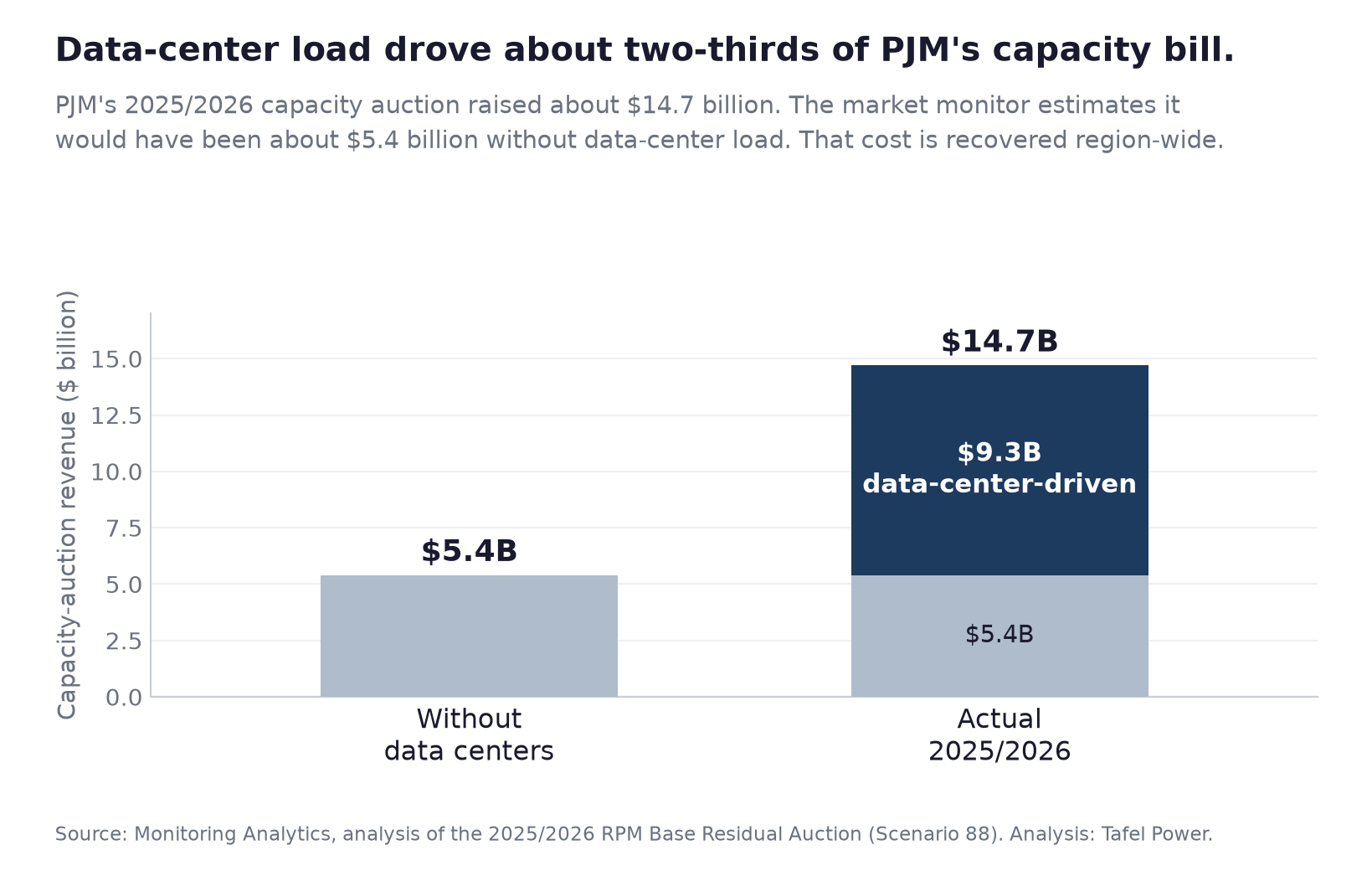
PJM is the grid covering 13 states and Washington DC. Total capacity-auction revenue for 2025/2026 was about $14.7 billion. Monitoring Analytics, PJM's independent market monitor, estimated it would have been about $5.4 billion without data-center load. Data-center demand accounts for the other $9.3 billion, about two-thirds of the total, which the monitor called the primary reason for the increase.
A Harvard Electricity Law Initiative paper found that utilities also shift data-center costs onto other ratepayers, and that confidential special contracts often hide the terms. A separate count by the Union of Concerned Scientists found utilities assigned $4.3 billion in data-center connection costs to customers in 2024 across seven mid-Atlantic states.
The tax benefit stays local
The other side of the ledger is real, and it is mostly fiscal. By its own count, Loudoun County, Virginia collects 38 percent of its general-fund revenue from data centers, which sit on about 4 percent of its commercial parcels. An NVTC study prepared by Mangum Economics estimates that without that revenue the county's residential tax rate would rise 91 percent, from $0.805 to $1.537 per $100. That benefit accrues to the county that hosts them.
The winner and the payer may be different places
This is the part the public debate misses. Loudoun's tax benefit is captured by one county. Capacity costs are recovered across PJM's customer base, subject to locational pricing and different retail cost-allocation rules. Households outside the host county may bear part of that regional cost while receiving none of Loudoun's local tax benefit. The benefit is captured locally while the cost is spread regionally. That geographic mismatch helps fuel the backlash.
Regulators are changing the allocation rules
The rules that decide who pays are being rewritten now, though none is settled.
In June 2026 FERC issued show-cause orders to all six regional grid operators: PJM, MISO, SPP, NYISO, CAISO, and ISO New England. Each must justify or revise the rules governing large-load interconnection and transmission service, and FERC named cost shifting, transparency, and financial security as the concerns. FERC issued tailored orders and rejected a single uniform approach.
Pennsylvania has adopted one of the most detailed state frameworks. In May 2026 its Public Utility Commission adopted a large-load model tariff framework to guide future utility filings, not yet a single binding statewide tariff. It addresses much of the checklist a fair deal needs: cost causation, financial security, protection for existing ratepayers, and letting a customer self-build certain upgrades.
Texas is moving on two tracks at the PUCT, a rulemaking for large-load interconnection standards (Project 58481) and a separate review of how wholesale transmission costs are recovered (Project 58484).
What a fair deal must contain
Whether a data center is a net public benefit comes down to three things.
Does the host community keep the tax benefit? Loudoun does, through property and equipment taxes. States often give some of it back through abatements, so a local gain can be a partial state loss.
Does the load pay the network and capacity costs it triggers? Where it does, other customers are protected. Georgia Power must backstop the cost of its approved build through 2031 if the load does not show. Louisiana structured the Meta deal so Meta covers its own cost of service. Where charges do not fully follow cost causation, some costs can shift to other customers. PJM shows how regional capacity costs can rise when data-center demand enters the load forecast.
Are the protections public and enforceable? This is where the public often cannot verify whether the test has been met. The Harvard work found that the deciding contracts are frequently confidential. A backstop that cannot be reviewed cannot be independently verified.
A project that answers those well addresses the central ratepayer objection and is easier to defend publicly. Where the answers are missing or confidential, the public cannot determine whether the project pays its full cost. The answer sits in the tariff, the customer contract, and the cost-allocation orders.
Methodology
Loudoun County's share figures, 38 percent of general-fund revenue from data centers on about 4 percent of commercial parcels, are from the county's public data-center tax FAQ. The counterfactual residential tax rate, a rise from $0.805 to $1.537 per $100 (a 91 percent increase) without data-center revenue, is from the Northern Virginia Technology Council's 2026 report prepared by Mangum Economics, an industry-commissioned study. The PJM figures are from Monitoring Analytics, PJM's independent market monitor, in its analysis of the 2025/2026 RPM Base Residual Auction: actual auction revenue of $14,687,047,358, and a scenario without embedded and forecast data-center load in which revenue would have been $5,354,943,499. Data-center load therefore accounts for $9,332,103,858, or 63.5 percent of actual revenue and a 174.3 percent increase over that counterfactual (Scenario 88); the monitor identifies data-center growth as the primary driver. The $4.3 billion in assigned connection costs is from a 2024 Union of Concerned Scientists analysis of seven mid-Atlantic states. The cost-shift and confidential-contract findings are from the Harvard Electricity Law Initiative (2025). The Georgia Power backstop and Louisiana Meta cost-of-service terms are from the Georgia Public Service Commission's December 2025 order and the Louisiana Public Service Commission's 2025 order. The regulatory actions are FERC's June 18, 2026 show-cause orders to the six RTOs; the Pennsylvania Public Utility Commission's large-load model tariff framework adopted in May 2026; and the Texas PUCT's large-load interconnection rulemaking (Project 58481) and transmission cost-recovery review (Project 58484). Figures reflect 2024 to 2026 snapshots and may have changed since.
All data compiled by Tafel Power from public sources. Framing informed by the firm's transaction advisory work in ERCOT and cross-ISO markets.
Questions, corrections or disagreement on any of this are welcome: kris@tafelpower.com
More from Insights
July 14, 2026
Cheapest Energy Isn't Cheapest Power
An illustrative benchmark of what a 500 MW load at a 95 percent load factor pays for delivered power across the seven organized markets. Wholesale prices cluster between 30 and 55 dollars per MWh. Delivered, the displayed totals run from about 36 to about 87.
July 13, 2026
The ERCOT Queue Cannot Distinguish Captive Gas from Speculation
For anyone screening ERCOT gas by interconnection status: a dedicated plant can be under contract to a named customer and still appear in the queue as unsigned and in study. Project Kilby shows why captive generation needs a separate diligence framework.