ERCOT's Signed, Near-Term Merchant Gas Is a Fifteen-Counterparty Market
For hyperscalers and infra funds procuring firm power: when the screened merchant set sits with a countable number of counterparties, price discovery is shaped more by relationship, timing, and project-specific alternatives than by broad competition.
For hyperscalers · For infra funds · ercot · gas · procurement · deal-structure · concentration
Kris Narayanan · Tafel Power · July 9, 2026 · 5 min read
The earlier Briefs established how much gas clears ERCOT's signed, near-term merchant screen this cycle (8.8 GW, merchant-screened, signed, with requested in-service dates by 2028) and where it sits (60 percent in West Texas). This one is about who holds it, because the answer changes how the power should be bought.
The screened counterparty set is countable and concentrated
The 8.8 GW screened set is held by roughly fifteen legal counterparties. Combine the entities that share a parent, and it is closer to eleven developers. That alone is a thin market. The concentration inside it is the part that matters:
- The top five parent developers hold about 80 percent of the screened set.
- The top three hold about 57 percent.
- The single largest parent developer holds about 28 percent of the screened merchant set.
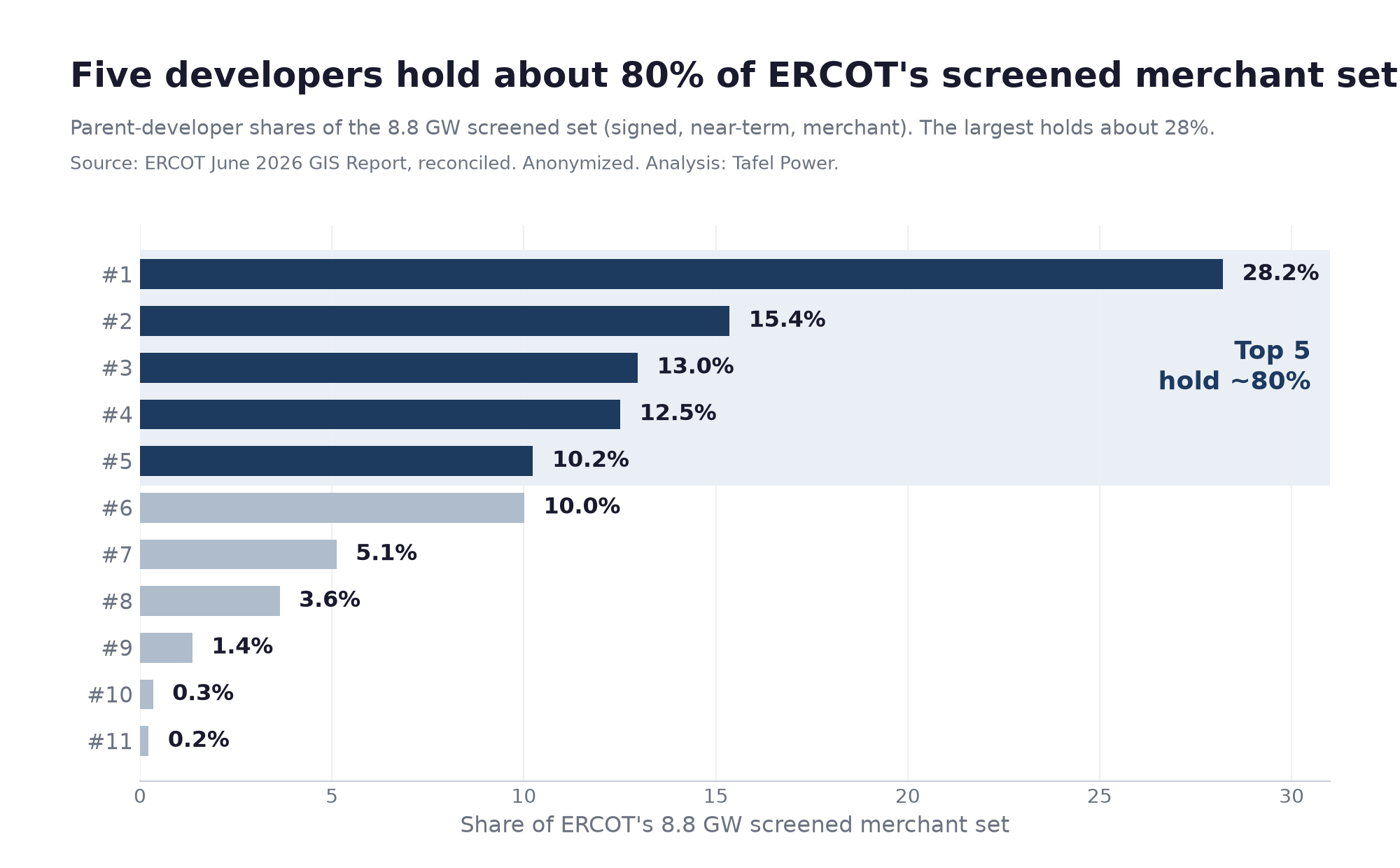
The screened set is a handful of majors and a tail of small positions rather than fifteen comparable counterparties, and it does not establish that all fifteen have power available for sale. A buyer seeking gigawatt-scale supply may need to engage a small subset of the largest developers, then determine which projects are actually uncontracted, commercially available, fuel-secured, and deliverable.
The 8.8 GW is a screened merchant set, not a forecast that all 8.8 GW will operate. Signed interconnection agreements improve the odds, but signed projects still fail or slip, so the capacity that ultimately reaches operation is likely to be smaller.
This is the signed, near-term merchant-screened set. It is not the whole firm-power market. Large buyers with the balance sheet, land, and operating appetite to build dedicated generation can bypass these counterparties through captive self-build. That is the strongest buyer alternative and a real limit on their pricing power. But buyers that cannot or do not want to become power developers still face a thin merchant pool. Captive projects also compete for the same turbines, construction capacity, and gas infrastructure, so they matter even when their power is not for sale. See The ERCOT Queue Cannot Distinguish Captive Gas from Speculation.
Why concentration changes the price mechanism
In a deep market, price discovery happens through competition: enough sellers, and the clearing price is the marginal cost of the next unit. That mechanism is much weaker here. With eleven developers holding the entire screened set and five of them holding most of it, there is no deep field of marginal sellers to set a competitive clearing price. Each large holder may hold pricing leverage over its own signed, near-term position, potentially giving the largest holders greater negotiating leverage over that scarce capacity. That leverage is bounded by the buyer's alternatives. Self-build, behind-the-meter generation, another zone, or simply waiting all cap what a holder can charge. Within the signed, near-term, screened set, though, concentration still tilts leverage toward the holder.
Pricing for a scarce, signed, near-term gas-development position may behave less like a simple spread over fuel cost and more like option value. The holder may be pricing the optionality of waiting for a better counterparty, given that a signed interconnection agreement with a near-term date is scarce and time-sensitive. The buyer is paying for access to a more advanced development position, not simply for energy. Treating this as a commodity procurement means waiting for competitive tension that a countable counterparty set may not generate. That is how a large load arrives at COD without contracted supply.
The screen also does not test firm fuel. A signed interconnection agreement says the plant has advanced on the grid side. It does not confirm firm pipeline transport, lateral capacity, storage, pressure, or winter fuel availability. That matters especially in West Texas, where 60 percent of the screened set sits.
What this changes for the buyer
Hyperscaler energy leads. Procurement here is origination work. The screened counterparty set is nameable and short, so the work is relationship coverage across the top five developers and moving early against them, before a competitor locks the same handful of top holders. Price the option value of a signed, near-term position, and secure it, rather than modeling a clearing price that this market structure may not produce.
Infra funds underwriting a gas platform. Concentration is the thesis and the risk at once. A platform that holds one of the top five positions may hold meaningful pricing leverage over a scarce, signed set. A platform built on the tail owns optionality that a larger holder can undercut on timing. Diligence where in the concentration curve the target sits, not just its nameplate.
Developers holding a top-five position. The position may carry scarcity value. As turbine-slot constraints and the financing, permitting, and fuel filters thin the speculative queue further, the value of a signed, near-term position rises against it.
For the largest holders, much of the value may lie in the option to wait for the right counterparty, not only in the underlying energy economics.
This is one of a four-Brief series on the firm-power decision: how much capacity is credible, what powers a 24/7 data center, who controls the screened merchant set, and where the load should sit.
Methodology
The screened set is the 8.8 GW of ERCOT gas that is merchant, holds a signed interconnection agreement, and targets a 2026 to 2028 in-service date, drawn from the June 2026 GIS Report and reconciled against an archived snapshot of that source before publication. Counterparty counts are developer entities in the report's Interconnecting Entity field; parent-level counts combine entities that share a common owner (for example, sequentially numbered project companies from one developer), assigned manually by matching project-company names rather than from a commercial ownership database. Concentration shares are by capacity. Merchant excludes cooperatives, municipal utilities, and public authorities. The earlier overlap Brief referred to roughly fifteen developers as shorthand; on entity reconciliation the precise figures are about fifteen legal counterparties and eleven parent developers. Because the 8.8 GW figure is derived from multiple filters applied to ERCOT GIS fields, it should be read as Tafel Power's filtered estimate of merchant, signed, near-term gas capacity, not as an ERCOT-published category. The screened set identifies projects meeting public queue criteria. It does not establish that the capacity is uncontracted, commercially available, financed, equipment secured, fuel secured, or physically deliverable to a particular load. Figures reflect the June 2026 snapshot and may have changed since.
All data compiled by Tafel Power from public sources. Framing informed by the firm's transaction advisory work in ERCOT and cross-ISO markets.
Questions, corrections or disagreement on any of this are welcome: kris@tafelpower.com
More from Insights
July 8, 2026
Batch Zero's Interim Framework and the $50,000 per MW Default
For developers with queue positions and offtakers structuring around them: what the new $50,000 per MW default financial security means for deal math.
July 7, 2026
ERCOT's Signed, Near-Term Gas Is Concentrated in West Texas
For hyperscalers siting loads and infra funds valuing gas platforms: the signed, near-term gas that clears the screen is concentrated in West Texas and nearly absent from the DFW load pocket.