Only 8.8 GW of ERCOT's Gas Queue Is Signed and Near-Term This Cycle
For hyperscalers pricing offtakes and infra funds valuing platforms: the ERCOT gas that is both signed and near-term is smaller than either filter suggests.
For hyperscalers · For infra funds · ercot · gas · interconnection · batch-zero · turbine-slots
Kris Narayanan · Tafel Power · July 6, 2026 · 3 min read
The ERCOT gas queue looks deep until the commercial filters are applied at once. The near-term projects are largely unsigned, and the projects with signed interconnection agreements are largely years away. Apply both filters and the merchant set is 8.8 GW, wide enough below the 69.7 GW headline to change how a deal is priced.
Three filters that barely overlap
Total queued gas in the June 2026 GIS report is 69.7 GW. Filter to a 2026 to 2028 commercial operation date and it is 27.8 GW. Filter instead to a signed interconnection agreement and it is 14.6 GW. The two barely overlap: much of the signed capacity carries a 2029 to 2031 date, and most of the near-term capacity has cleared no interconnection agreement. Their intersection, gas that is both signed and near-term, is 9.7 GW. About 0.9 GW of that is public-authority self-build, mostly LCRA, which no merchant offtaker can buy, leaving a merchant screened set of 8.8 GW.
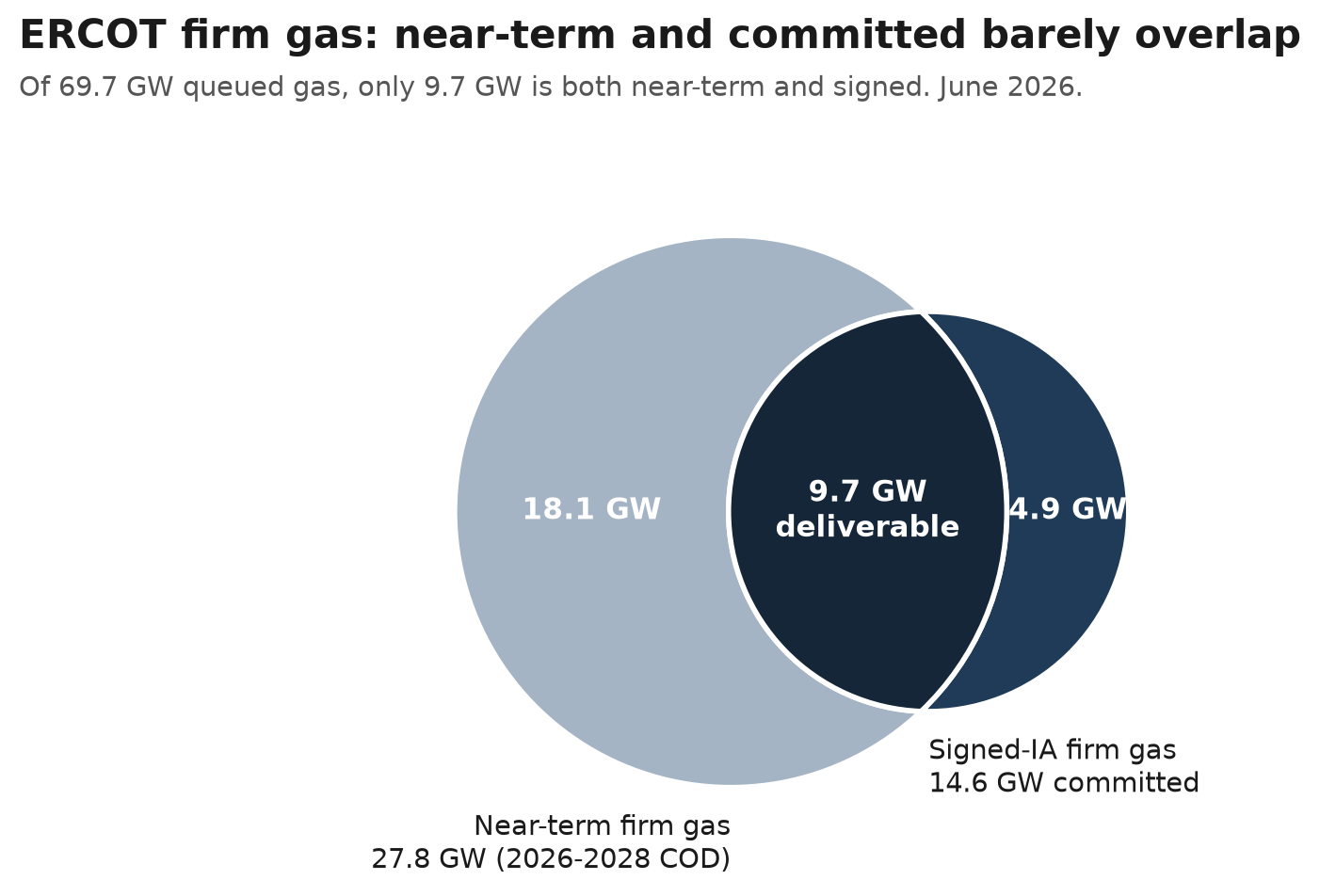
Why 8.8 GW is the number that matters
8.8 GW is 13 percent of the gross gas queue. It is the strict signed, near-term merchant screen for ERCOT over the next three years, and small enough that the counterparties can be named. The set sits in roughly fifteen legal counterparties and eleven parent developers. When the screened inventory is that concentrated, firm power is priced by relationship and option value, not by the kind of clearing auction a market this small is unlikely to produce.
Large load financial security requirements under PUCT Project 58481 may reduce speculative demand and change which buyers advance to contract execution. They do not directly reduce the unsigned gas generation queue. On the supply side, the more immediate filters remain interconnection progress, financing, permitting, fuel arrangements, and turbine availability, where slot reservations and pricing are both moving against buyers.
Unsigned does not always mean speculative. Some unsigned projects may be captive generation committed to a named load rather than merchant capacity seeking a buyer. Those projects do not belong in the 8.8 GW screened merchant set, but they may still be highly likely to build. See The ERCOT Queue Cannot Distinguish Captive Gas from Speculation.
What this changes for each buyer
Hyperscaler energy leads pricing offtakes in ERCOT. Secure options early against a named, countable set, rather than waiting for a clearing price that a market of roughly fifteen counterparties is unlikely to produce. The signed, near-term merchant-screened inventory before 2029 is 8.8 GW, and transactions around it are likely to depend heavily on relationships, timing, and option value.
Infra funds underwriting large-load or gas platform acquisitions. The screened denominator is 8.8 GW, not 27.8 GW. A model built on the near-term figure is counting the roughly 19 GW of near-term capacity that is either unsigned or not part of the merchant-screened set, which may never connect on schedule. Diligence the interconnection agreement and the turbine slot, not the queue position.
Developers holding signed, near-term gas positions. Signed, near-term gas is the scarce asset. Turbine slots are tightening, and financing, permitting, and fuel arrangements gate the unsigned projects. That widens the gap between a signed position and a speculative one.
Methodology
Figures are drawn from the ERCOT June 2026 GIS Report (Large and Small Gen, projects with a Full Interconnection Study requested) and reconciled against an archived snapshot of that source before publication. "Signed IA" reflects the report's IA Signed field, corroborated by the GIM Study Phase field. Where the two disagree, the more conservative non-signed reading is used. Near-term means a developer-requested COD of 2026 to 2028, which skews optimistic and should be read as an upper bound. Merchant excludes cooperatives, municipal utilities, and public authorities. Figures reflect the June 2026 snapshot and may have changed since.
Because the 8.8 GW figure is derived from multiple filters applied to ERCOT GIS fields, it should be read as Tafel Power's filtered estimate of merchant, signed, near-term gas capacity, not as an ERCOT-published category. The screened set identifies projects meeting public queue criteria. It does not establish that the capacity is uncontracted, commercially available, financed, equipment secured, fuel secured, or physically deliverable to a particular load.
All data compiled by Tafel Power from public sources. Framing informed by the firm's transaction advisory work in ERCOT and cross-ISO markets.
Questions, corrections or disagreement on any of this are welcome: kris@tafelpower.com
More from Insights
July 5, 2026
Which ERCOT Queue Capacity Has a Signed Interconnection Agreement?
June 2026 snapshot. 434 GW in queue. 134 GW with signed interconnection agreements. Breakdown by technology.
July 2, 2026
When Faster Power Stops Being Expensive
The best way to energize early is not fixed. It moves with what your load earns, and on the illustrative case it changes twice: once at about $49 per MWh and again at about $114.