Which ERCOT Queue Capacity Has a Signed Interconnection Agreement?
June 2026 snapshot. 434 GW in queue. 134 GW with signed interconnection agreements. Breakdown by technology.
ercot · interconnection · reference-data
Kris Narayanan · Tafel Power · July 5, 2026 · 1 min read
A reference snapshot of the ERCOT interconnection queue as of the June 2026 GIS report, split by technology and by interconnection agreement status.
The queue totals 434 GW across 1,828 active projects. Of that, 134 GW, about 31 percent, carries a signed interconnection agreement. The gross number and the signed number tell opposite stories: the headline suggests oversupply, while the signed subset shows how much thinner the signed stack is.
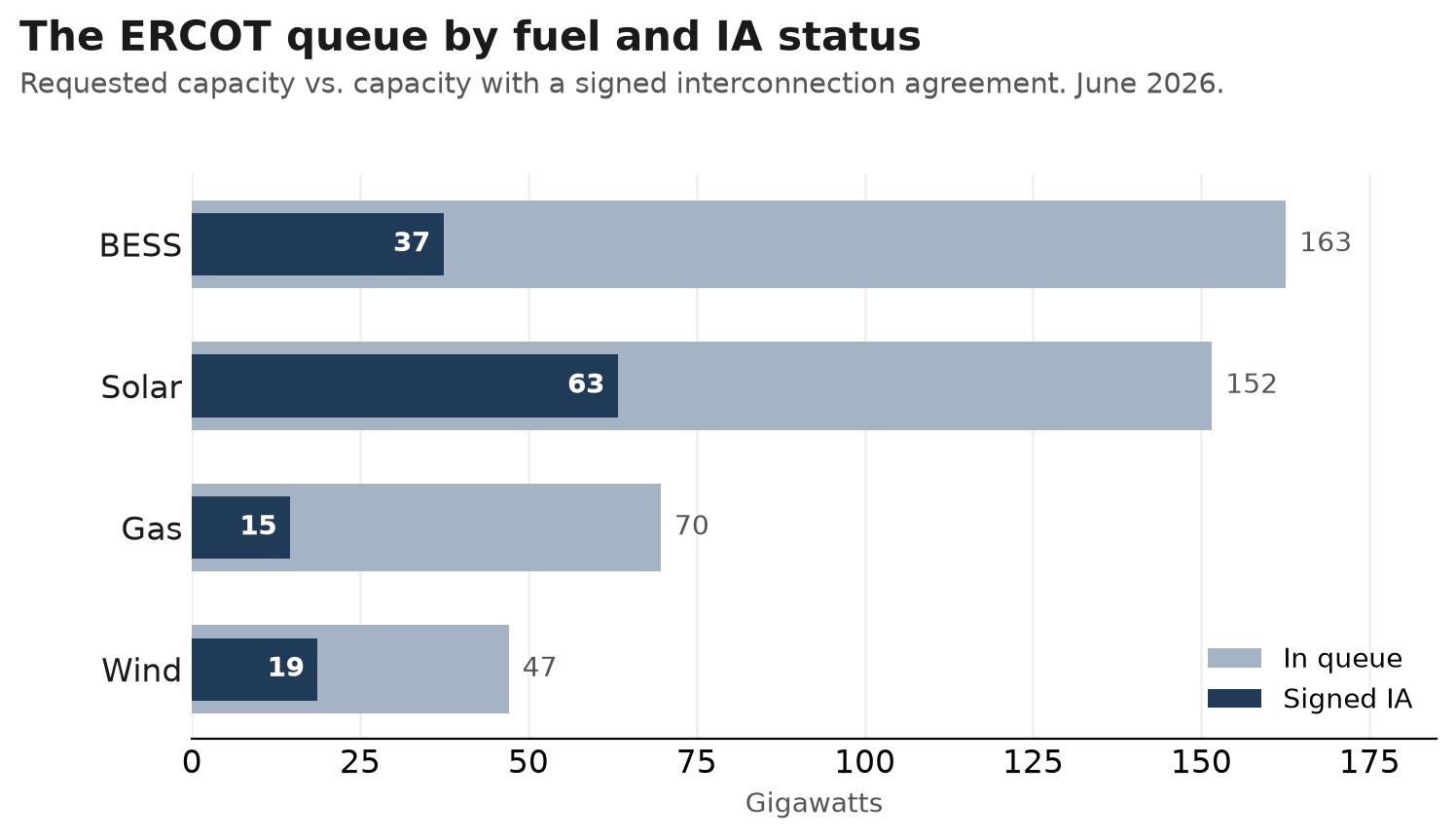
Batteries lead the queue at 162.6 GW, but only 37.4 GW is signed. Solar is 151.6 GW with 63.3 GW signed. Gas is 69.7 GW with 14.6 GW signed, the lowest signed share of the four. Wind is 47.1 GW with 18.7 GW signed.
The pattern to carry forward: signed interconnection agreements are a better starting point than gross queue capacity for judging project maturity, though a signed agreement is not the same as delivered capacity. Gas, the principal dispatchable resource in the queue, has the widest gap between what is queued and what is signed.
Methodology
Figures are drawn from the ERCOT June 2026 GIS Report (Large and Small Gen, projects with a Full Interconnection Study requested) and reconciled against the source file before publication. "Signed IA" reflects the report's IA Signed field. Figures reflect the June 2026 snapshot and may have changed since.
Questions, corrections or disagreement on any of this are welcome: kris@tafelpower.com
More from Insights
July 2, 2026
When Faster Power Stops Being Expensive
The best way to energize early is not fixed. It moves with what your load earns, and on the illustrative case it changes twice: once at about $49 per MWh and again at about $114.
June 30, 2026
The Real AI-Power Risk Sits Downstream of the Megawatts
For anyone siting or financing AI infrastructure: new AI hardware arrives on a two-year cycle while the delivery infrastructure built for it is financed for decades. Firm megawatts are necessary but interchangeable; the harder thing to secure is delivery that can absorb several hardware generations without a major retrofit.