The Real AI-Power Risk Sits Downstream of the Megawatts
For anyone siting or financing AI infrastructure: new AI hardware arrives on a two-year cycle while the delivery infrastructure built for it is financed for decades. Firm megawatts are necessary but interchangeable; the harder thing to secure is delivery that can absorb several hardware generations without a major retrofit.
For hyperscalers · For infra funds · For developers · data-centers · gpu · power-demand · firm-power · grid
Kris Narayanan · Tafel Power · June 30, 2026 · 5 min read
The debate about AI and energy usually asks whether the models will burn a lot of power. The harder question is whether the grid can be built as fast as the hardware that consumes it. It cannot, and the gap is built in: new hardware generations arrive roughly every two years, while the power and cooling built to deliver them are financed for decades.
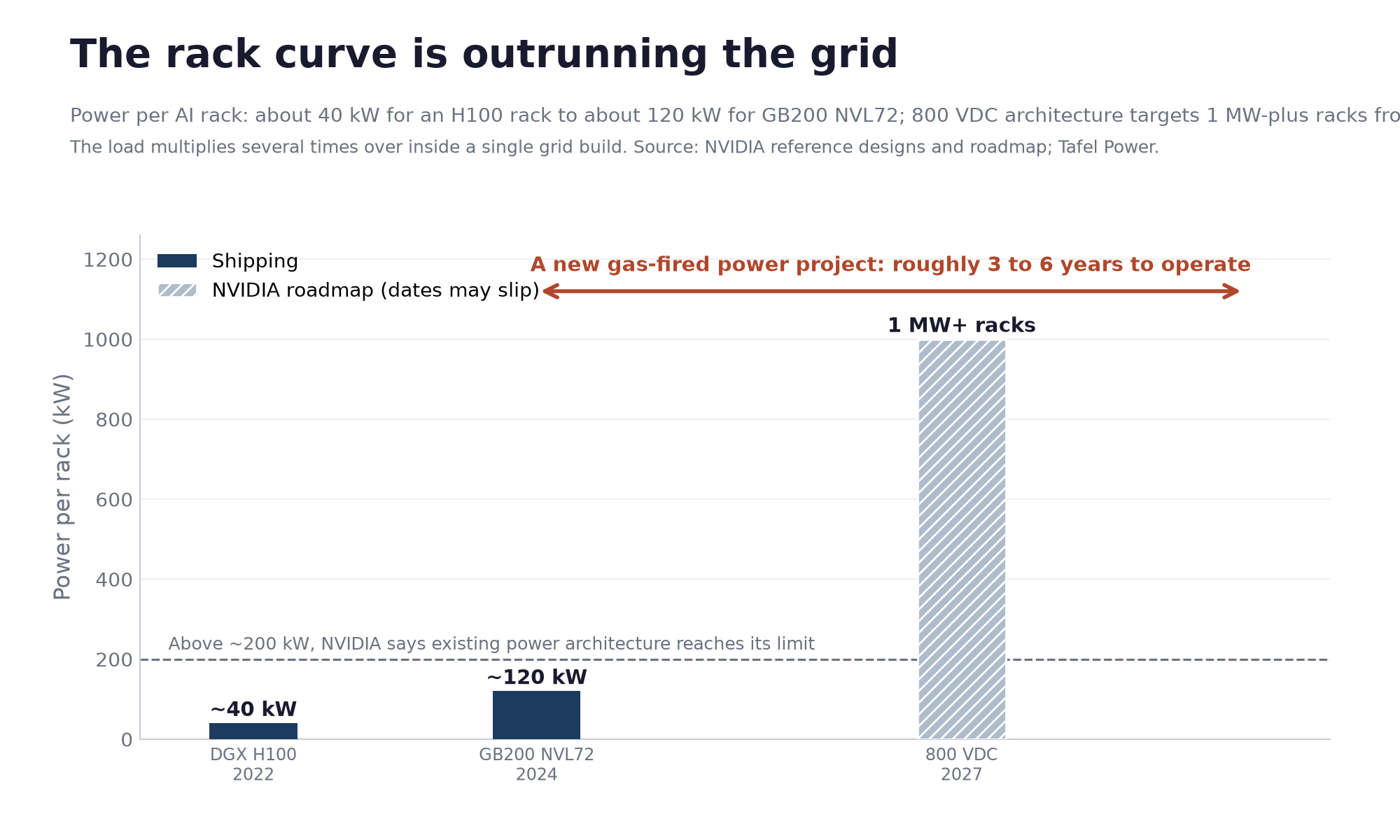
Start with the rack. In 2022, a reference rack of four NVIDIA DGX H100 systems drew about 40 kilowatts. The GB200 NVL72 shipping now draws approximately 120 kilowatts at full load, and facility designs commonly allow for more. NVIDIA says rack designs exceeding 200 kilowatts strain traditional 54-volt DC rack distribution and need a new approach, and it describes 800-volt DC as a facility-level architecture, converting grid AC directly to 800-volt DC, to support 1 MW IT racks and beyond beginning in 2027. During the development of a single gas-fired power project, several hardware generations can arrive, changing rack density, cooling load, voltage architecture, and load behavior.
The chip curve underneath it
The rack power curve is driven partly by rising accelerator module power, and partly by greater system density, CPUs, networking, and power-conversion equipment.
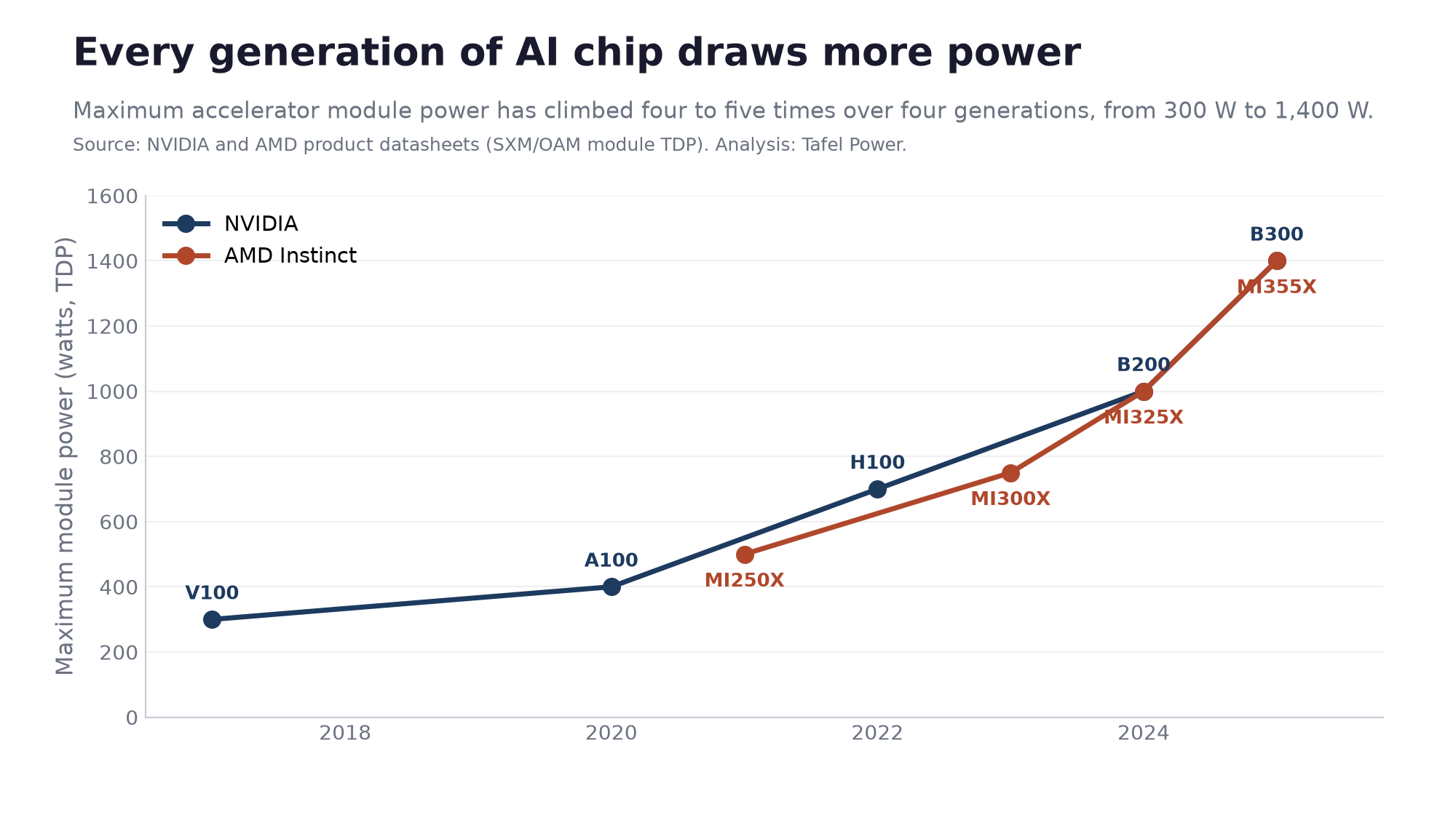
A data-center accelerator's maximum module power was 300 watts in 2017, NVIDIA's V100, then 400 in 2020, 700 in 2022, and 1,000 to 1,400 in the Blackwell generation shipping now. AMD's Instinct line traces the same slope, from 500 watts to 1,400. Power per chip has climbed four to five times over four generations, and roughly 2.5 to 3.5 times since 2020, with new generations arriving every two years or so. The trend has held across four generations, so it reflects where the technology is going rather than a spike in any single product.
Higher rack power does not by itself determine how much electricity a data center will require. Newer systems can perform the work of several older racks, reducing the rack count for a given workload, and total facility demand depends on the amount of compute deployed, the performance and efficiency of each system, utilization, redundancy, and cooling overhead. So the hardware curve does not imply that every facility consumes proportionally more power. Its real significance is that each rack, data hall, and interconnection point can now hold far more compute and electrical load, even as aggregate demand for AI computation keeps growing.
Growing faster than the grid can be built
Company announcements show the scale operators are preparing to support. Meta has described Prometheus at about 1 GW and Hyperion as capable of scaling toward 5 GW. OpenAI reported nearly 7 GW of planned Stargate capacity in September 2025 and maintained a broader 10 GW infrastructure commitment. These are planned-capacity figures, not measurements of current electricity consumption, installed rack counts, or continuous utilization.
Total demand keeps rising. US data centers drew about 22 gigawatts of average power in 2024. Berkeley Lab's June 2026 reference case estimates they could consume 649 terawatt-hours in 2030, about 74 gigawatts of average continuous demand, across a scenario range of 521 to 843 terawatt-hours. That estimate rests on expected equipment shipments, per-device electricity use, utilization, and cooling, not on multiplying future rack power by today's rack count.
Load concentrates locally. As high-density racks multiply across a campus, hundreds of megawatts concentrate behind a limited number of substations and transmission paths. Density turns a national demand story into a local interconnection problem, which is exactly where firm power is scarce.
The hardware outpaces the grid. This is the part that matters for a deal. Chip design power climbs on a roughly two-year cadence. The assets that feed it do not move at that speed. A new gas-fired power project can require roughly three to six years to become operational, generation projects have recently spent about five years in the interconnection process alone, and major transmission frequently takes longer still. So the hardware can pass through multiple generations inside a single grid build, and anyone committing thirty-year power infrastructure is committing it to a load whose size and shape will turn over several times before the concrete cures.
What it changes for the decision
The obsolescence risk in AI infrastructure is usually framed as a chip problem: will the GPUs still be competitive. Seen from the power side it is the opposite, and it splits in two. Upstream firm power, from a plant, a utility, or a grid connection, stays usable whatever the GPU architecture. The adaptability risk sits downstream, in the delivery layer that turns a grid connection into a powered rack: rectifiers, switchgear, busways, protection, energy storage, cooling, and data-hall design. That layer is built and financed for decades, while new hardware generations arrive roughly every two years.
So the sharper risk is less about whether enough megawatts exist and more about how many hardware generations a facility can absorb before it needs a material retrofit, significant downtime, or fresh capital. That question is measurable:
- Retrofit capital per firm MW, and the downtime a conversion requires.
- The supported rack-density range, and spare electrical and cooling headroom above today's load.
- Whether the facility can support a phased move from 415 or 480-volt AC distribution to 800-volt DC while running both legacy AC-fed and future DC-fed racks.
- Expansion capacity at the substations and data halls.
- Who carries the upgrade cost under the lease.
The tenor mismatch is what drives this. A gas plant, a substation, and the debt behind them are twenty- to thirty-year commitments, while the hardware they serve moves through a new generation about every two years. Firm megawatts are necessary, but one supplier's are much like another's. The harder asset to secure is delivery infrastructure that can carry several generations of AI hardware without a rebuild, so underwriting the megawatts alone leaves out most of the risk. What to underwrite is the cost, the downtime, and the technical pathway of that delivery layer.
Methodology
Accelerator power figures are the published thermal design power from NVIDIA and AMD product datasheets, at the SXM or OAM module level. Rack figures are from NVIDIA reference designs (DGX H100, GB200 NVL72) and NVIDIA's publicly presented roadmap (Vera Rubin and the 800-volt architecture for 1 MW IT racks); roadmap figures and dates are as stated by the vendor and may change. US demand figures are the reference case in Berkeley Lab's United States Data Center Energy Usage Report: 2025 Update (June 2026). Campus figures are from Meta and OpenAI announcements. Grid build lead-times reflect Tafel Power's firm-power work. Figures reflect public disclosures and vendor roadmaps available through June 2026.
All analysis by Tafel Power from public sources.
Questions, corrections or disagreement on any of this are welcome: kris@tafelpower.com
More from Insights
June 25, 2026
West Virginia Leads PJM in Queued Gas. Most of It Is One Project.
For developers and data centers eyeing West Virginia: the state's headline gas number is real, but the screened set is tiny, and for some projects the practical path is self-supply or dedicated generation.
June 15, 2026
LCOE Is Not a Deal Price
Published cost curves rank technologies by dollars per megawatt-hour at the plant gate. A firm-power buyer pays for a firm megawatt, delivered at a site, on a date. Three adjustments reshape that comparison and reorder the ranking.