The ERCOT Queue Has Fewer, Bigger Projects
For developers and infra funds: the project count fell through late 2025 while total requested capacity rose, so the average project is larger.
For developers · For infra funds · ercot · interconnection · data-centers · queue
Kris Narayanan · Tafel Power · February 18, 2026 · 1 min read
A shrinking queue usually means fewer projects and less capacity. In ERCOT through late 2025, only one of those was true.
Two numbers moving apart
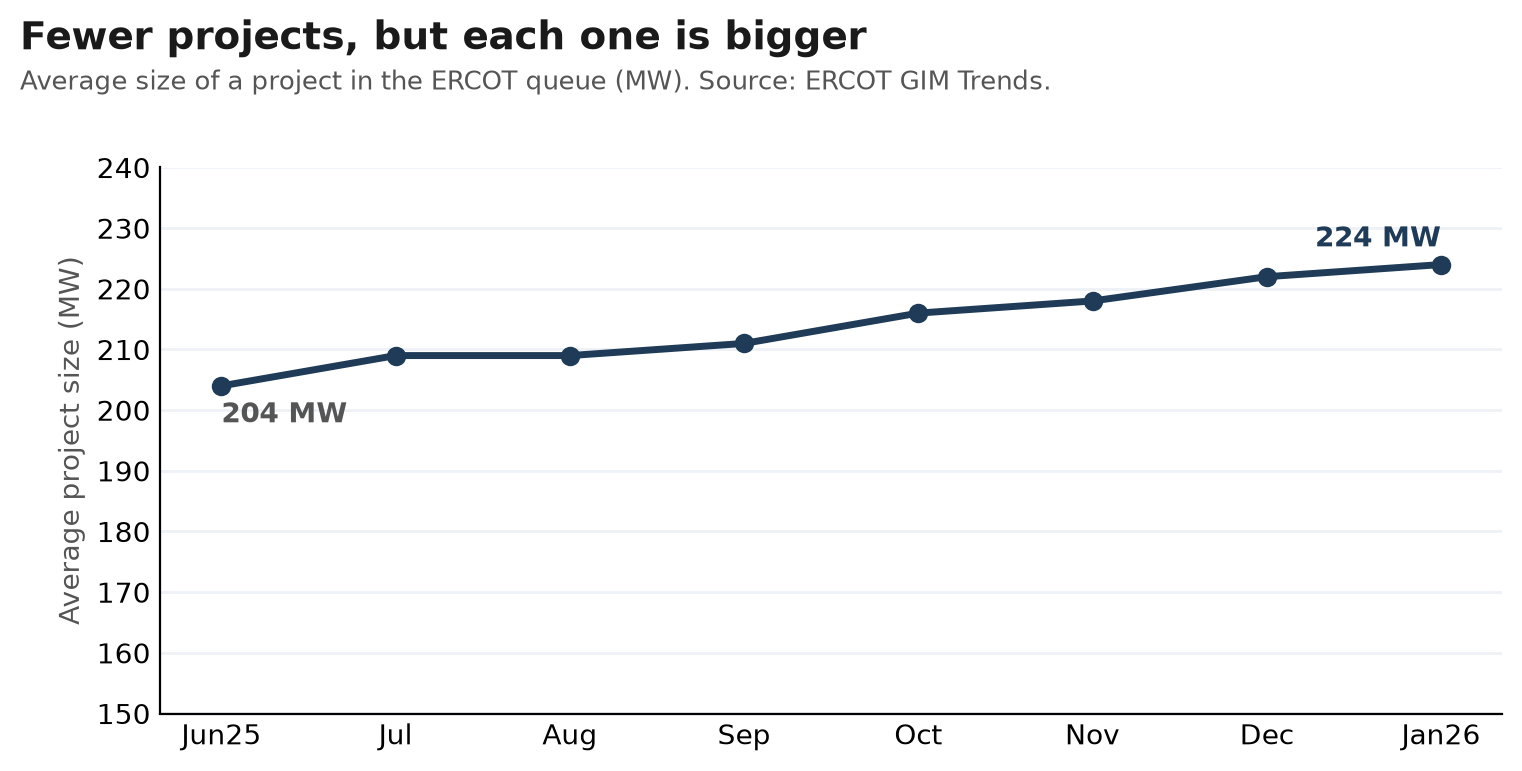
In mid 2025 the queue held about 2,050 projects. By early 2026 it was under 2,000, but total capacity went up over the same stretch, so each project got bigger. The average grew from about 204 MW to 224 MW.
What the shift does and does not show
The shift shows that requested capacity is becoming concentrated in larger projects. Average size alone does not establish financing quality or development certainty, but it changes how queue concentration, network upgrades, and project failure risk should be evaluated.
What it means
For developers, the requested-capacity mix is concentrating in larger projects. Size alone does not prove those projects are better funded or more likely to build, so the queue-level read has to be paired with project-level status.
For funds, do not judge the queue by how many projects it holds, or assume bigger means healthier. Judge it using project-level status, sponsor quality, signed agreements, financing, and other evidence of development maturity.
Methodology
Project counts and capacity from ERCOT's GIM Trends series in the monthly GIS report. Average size is total requested capacity divided by project count. All data compiled by Tafel Power from public sources. Framing informed by the firm's transaction advisory work in ERCOT and cross-ISO markets.
Questions, corrections or disagreement on any of this are welcome: kris@tafelpower.com
More from Insights
January 15, 2026
Gas, Not Renewables, Is Driving ERCOT's Queue Growth
For developers and large power buyers: the queue total keeps rising, but nearly every new gigawatt is a single fuel.