Every Megawatt Has an Exchange Rate
MISO's summer capacity price was 56 times its spring price, and summer is when it counts a battery least. A yearly average hides both.
For utilities · For developers · For infra funds · miso · capacity-market · storage · gas · contracts
Kris Narayanan · Tafel Power · November 12, 2026 · 6 min read
MISO, the grid operator for much of the Midwest and South, runs a capacity auction each year. It pays resources for being available when the grid needs them, and it sets a separate price for each season.
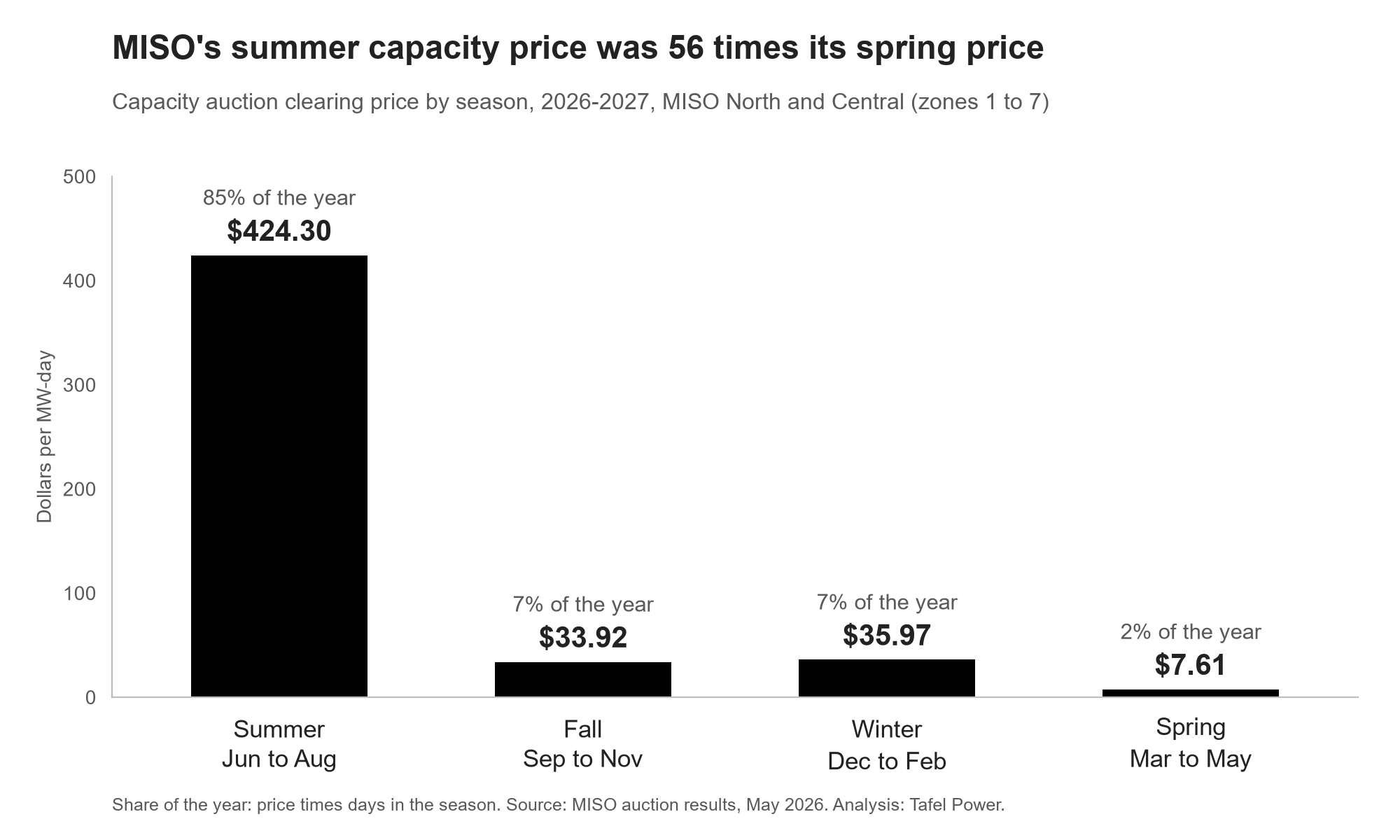
What it shows: summer cleared at $424.30 per MW-day and spring at $7.61 per MW-day. Counting the days in each season, summer was 85% of the year's capacity price.
These are 2026-2027 prices for MISO North and Central (zones 1 to 7), about three quarters of MISO's summer requirement. Fall, winter and spring cleared at one price across all of MISO. The year before, summer also dominated, at $666.50 per MW-day.
MISO does not count every megawatt the same
The price is paid on capacity credit: the share of a plant's installed size that MISO counts toward reliability. FERC accepted a new method for setting it in October 2024. MISO will first use it for the 2028-2029 planning year and publishes estimates each year until then. Here "gas" means MISO's combined cycle class.
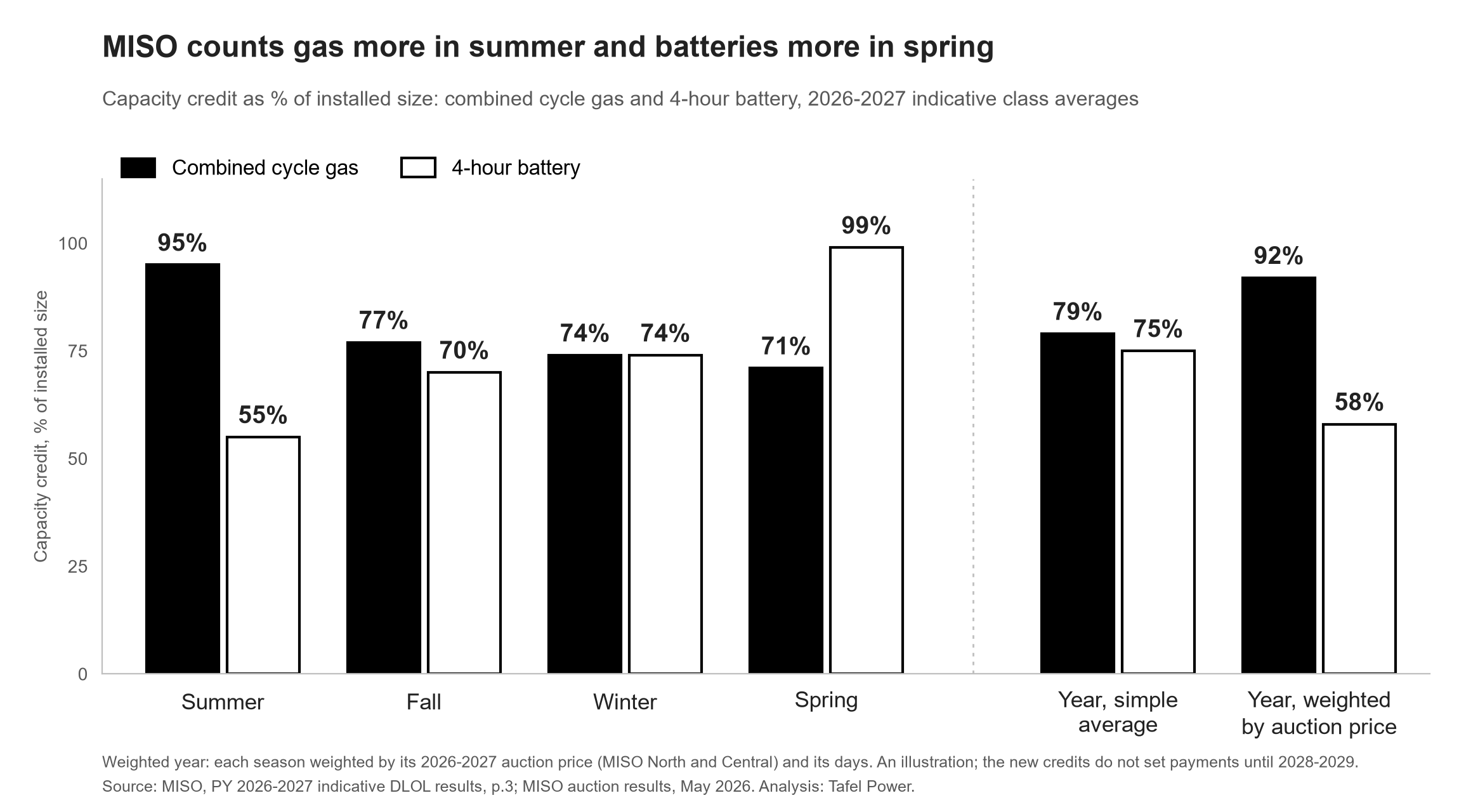
What it shows: gas gets more credit than a battery in summer, the same in winter and less in spring. A simple yearly average of the credits puts them close, at 79% for gas and 75% for the battery. Weighted by seasonal auction prices, gas comes to 92% and the battery to 58%. The weighted figures are our blend of MISO's credits, not a credit MISO assigns.
The same numbers, as the battery needed to match a gas plant:
| Season | Gas credit | Battery credit | Battery needed to match 100 MW of gas |
|---|---|---|---|
| Summer | 95% | 55% | 173 MW |
| Fall | 77% | 70% | 110 MW |
| Winter | 74% | 74% | 100 MW |
| Spring | 71% | 99% | 72 MW |
What it shows: matching 100 MW of gas takes 173 MW of battery in summer and only 72 MW in spring. These are class averages, so they illustrate the pattern rather than size a specific plant.
Why the credit swings
The new method credits a plant for what it delivers in critical hours, the hours MISO's model finds the grid most likely to run short. Those hours look different in each season.
- Summer. Combined cycle plants earn 95%. MISO says a 4-hour battery does best when a stress event lasts under five hours. The battery's summer credit, 55%, is its lowest of the year.
- Fall, winter and spring. MISO says thermal plants earn less outside summer because planned maintenance and cold weather outages fell in critical hours. Combined cycle drops to between 71% and 77%. The battery rises, to 99% in spring.
Think of it as being paid for showing up to the hardest shifts. Gas plants miss more shifts outside summer, for maintenance or cold. A 4-hour battery covers a short shift but not a long one.
The credits also move from year to year. Between MISO's last two releases, the battery's summer credit fell from 61% to 55% and its spring credit rose from 90% to 99%. MISO does not explain the change. We note the battery class is small, 67 units in 2026-2027, so its values can move.
What one megawatt would earn
Multiply each season's price by its credit and its days. This shows what one installed megawatt would have earned in capacity payments if the new credits had applied in 2026-2027. It is an illustration, not what any plant was paid.
| Season | Gas, $ per installed MW | Battery, $ per installed MW |
|---|---|---|
| Summer | $37,084 | $21,470 |
| Fall | $2,377 | $2,161 |
| Winter | $2,396 | $2,396 |
| Spring | $497 | $693 |
| Year | $42,353 | $26,719 |
What it shows: summer is 88% of a gas megawatt's capacity value and 80% of a battery's. Over the year, a battery megawatt earns about 0.63 of a gas megawatt in capacity payments. Rows may not add due to rounding.
The same credits give two exchange rates. Matching summer credit takes 1.73 MW of battery per MW of gas. Matching a year of capacity payments takes 1.59 MW. If a buyer has no spare capacity in any season, summer sets the size.
Two more limits apply. The illustration counts capacity payments only. A battery also earns from energy price spreads and ancillary services, and a gas plant earns an energy margin; both are left out. And prices move. At 2025-2026 prices ($666.50 summer, $91.60 fall, $33.20 winter and $69.88 spring, all per MW-day) and that year's credits, the battery came to 0.72 of a gas megawatt.
What it means in a deal
For a seller, MISO runs four seasonal auctions, and summer is 85% of the year's capacity price. So a seller is really selling four products under one name. A gas plant earns its best credit where the money is. A battery earns its best credit, 99%, in the season that paid $7.61 per MW-day. That spring credit is worth $693 a year per installed MW, against $21,470 for its 55% in summer. Capacity is also one revenue stream among several. Energy, ancillary services and a bilateral contract carry the rest, and the contract is where the price gets negotiated.
For a buyer, MISO sets a separate capacity requirement for each season. So a resource choice changes the buyer's position in all four seasons at once. Spare credited capacity absorbs the change. Where there is none, the difference must be built or bought at that season's price. With no spare in any season, summer sets the size: 173 MW of battery per 100 MW of gas. A yearly average says 106 MW, which leaves the buyer about 66 MW of battery short in summer, or about 36 MW of summer credit. (Before rounding, the two figures are 172.7 MW and 106.4 MW.)
What to do with this:
- Agree up front who carries a change in MISO's credits. The new method first sets credits for 2028-2029, and its indicative values have already changed between releases.
- Weight each season by what it pays, not equally.
- Check every season, and cover the largest gap the portfolio cannot absorb.
Method and sources
Capacity credits are MISO's indicative class averages under its Direct Loss of Load method, from MISO's PY 2026-2027 indicative results (p.1 and p.3) and PY 2025-2026 indicative results (p.3). FERC accepted the method in October 2024 (189 FERC 61,065). Battery values use MISO's "Even Loss" storage method (PY 2026-2027 results, p.3) and assume 4-hour batteries (PY 2025-2026 results, p.3). Seasonal requirements and seasonal auctions come from FERC's order of 31 August 2022 (180 FERC 61,141).
Auction clearing prices are from MISO's own Planning Resource Auction presentations to the Missouri Public Service Commission (28 May 2026, p.21-24; 21 May 2025, p.21-24). The 2025-2026 fall price is MISO North and Central; the south cleared at $74.09 per MW-day. Season lengths are calendar days: summer June to August (92), fall September to November (91), winter December to February (90), spring March to May (92). Summer's months are from FERC's 2022 order (note 16); the other three are our assumption, and weighting the 2026-2027 prices by these days reproduces MISO's annualized price of $126.19 per MW-day (May 2026 deck, p.5).
The exchange rates, weighted credits and capacity values are our arithmetic. This piece covers capacity only. It does not cover delivery to a location (congestion and losses) or covering a flat load in every hour.
Questions, corrections or disagreement on any of this are welcome: kris@tafelpower.com
More from Insights
October 28, 2026
Half a Gas Plant's Earnings Came on 1 Percent of Its Days
Fifteen years of Texas power prices show that the days that create most of a gas plant's value are the days it is hardest to deliver.
October 25, 2026
The AI Campus Could Leave America. So Far It Has Not.
Every US site now has two gates: whether the grid can serve it, and whether the local utility's rates make the data center pay its own way.