Gas Turbines Are Scarce. The Turbine Maker Reports a Thinner Margin.
What every part of the data center power supply chain actually reports, from utilities to software. The turbine maker, holding the acknowledged bottleneck, reports 18.8 percent on an EBITDA basis, against 27.5 percent operating at Eaton. Four parts of the chain disclose no separable return at all.
For hyperscalers · For infra funds · For developers · For utilities · supply-chain · procurement · firm-power · equipment · utilities
Kris Narayanan · Tafel Power · August 6, 2026 · 7 min read
Enough is public to map the visible returns. Four parts of the chain publish nothing separable. Here is what can be seen, part by part, with two cautions that both matter.
Nobody discloses a data-center-attributable margin. Not one company here. Eaton's Electrical Americas serves utilities, industry, commercial and residential customers alongside data centers. ABB's electrification division is broader still. GE Vernova's Power segment includes steam and nuclear. Quanta's electric segment is utility work generally. So these are whole-segment figures for businesses that serve this build among other markets. Vertiv's is company wide rather than a segment. The attribution gap is part of the finding.
The measures are not one object. Operating margin, EBITDA margin, gross margin and an allowed return on equity are different things, and companies choose which to publish. Each figure below carries its label, and none is ranked against another here. Scarcity does not map mechanically to reported profitability.
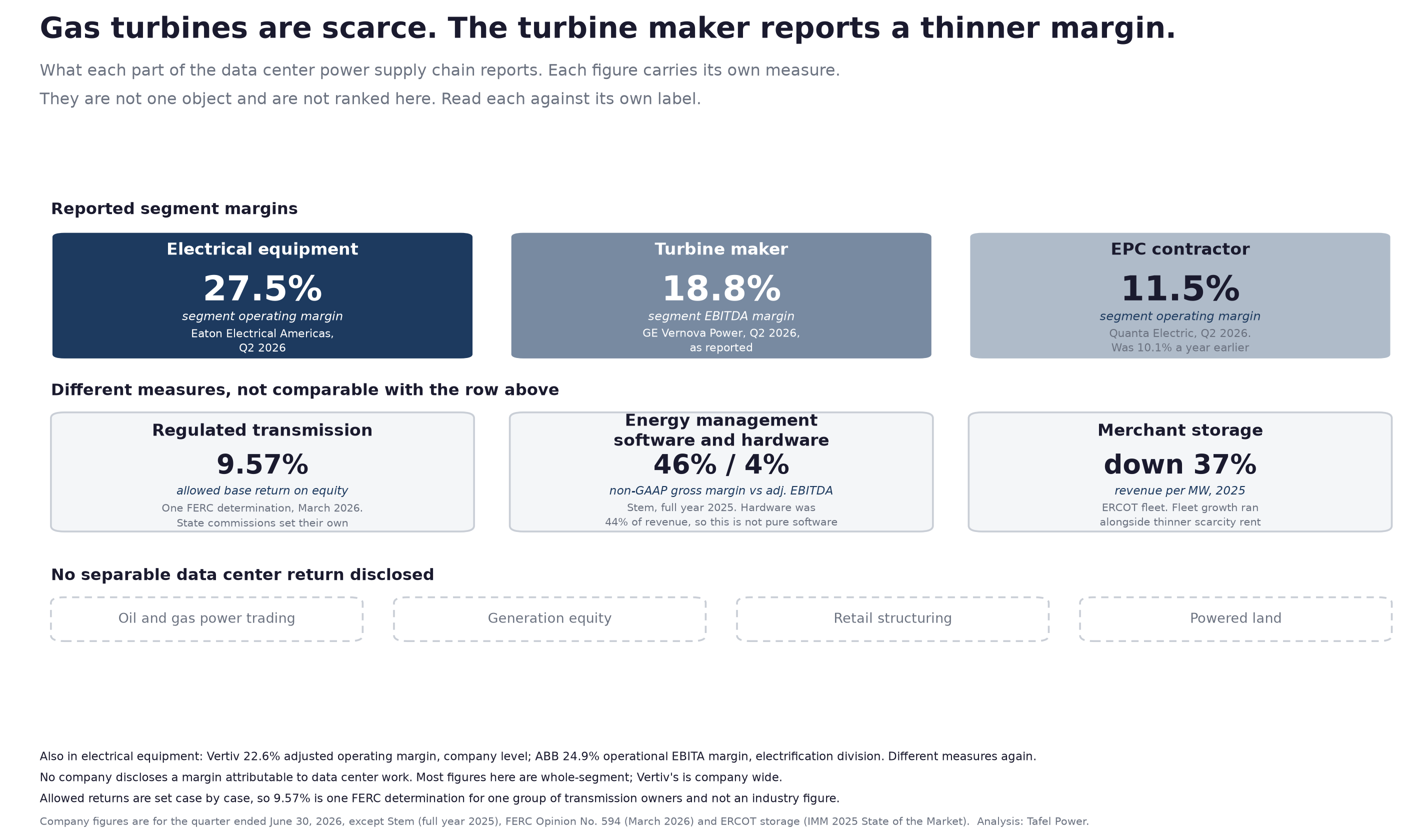
Electrical equipment reports the most
Eaton reported record Electrical Americas sales of $4.0 billion for the June 2026 quarter, up 18 percent organically, at a 27.5 percent segment operating margin, with record segment operating profit of $1.1 billion. Orders were up 41 percent on a twelve-month rolling basis.
Vertiv reported a 22.6 percent adjusted operating margin, up 410 basis points from a year earlier, and attributed part of that to favorable price against cost. It ended the quarter in a net cash position.
ABB reported a 24.9 percent operational EBITA margin in electrification, up 100 basis points, with divisional orders passing $7 billion for the first time. On the same earnings call its chief financial officer said the company still had a gap on price to cost. Pricing contributed to revenue, and ABB attributes the margin improvement primarily to operating leverage and efficiency.
One detail complicates the easy story. Vertiv is one of the most data-center-exposed names here and reports a lower margin than Eaton, on a measure sitting at a similar place in the income statement. If concentrated exposure to this build set margin, that would run the other way.
The turbine maker reports less
GE Vernova sells the machine everyone calls the bottleneck. In the June quarter it took $16.7 billion of Power orders, up 134 percent organically, signed 20 GW of new gas equipment contracts, moved gas equipment backlog and slot reservations from 100 to 116 GW, and now expects at least 125 GW by year end.
Its Power segment reported an 18.8 percent segment EBITDA margin, up 240 basis points, on segment EBITDA of $1,031 million against revenue of $5,477 million.
Note what that comparison does. EBITDA sits above depreciation and amortization, so it is the more generous of the two measures. The turbine business is being measured kindly and still reports less than Eaton's operating margin. Scarcity is not converting into the highest reported margin in this supply chain.
Quanta's grid segment reports about eleven percent
Quanta, which builds the grid, reported record revenue of $9.56 billion against $6.77 billion a year earlier, with adjusted EBITDA up 59.5 percent to $1.07 billion and backlog at a record $53.4 billion. Its Electric segment reported an 11.5 percent operating margin for the quarter, on operating income of $898.2 million against segment revenue of $7.84 billion, up from 10.1 percent a year earlier.
That is record volume on a thin retained percentage. A constructor sells labor and schedule rather than a product, and on its fixed price work it carries the cost and schedule risk.
Transmission owners earn what a regulator allows
This is the part people assume is safe. The protection is also the ceiling.
In March 2026, in Opinion No. 594, FERC set the base return on equity for New England transmission owners at 9.57 percent, with a maximum of 12.09 percent including incentives. It applied that retroactively to October 2014 and ordered refunds with interest. In April the owners applied to have the base lifted to 11.39 percent.
Three things to take from that rather than the number itself.
It is one determination, for one group of owners, under one jurisdiction. State commissions set allowed returns for their own utilities case by case, and they differ. Do not read 9.57 percent as an industry figure.
An allowed return on equity is not a margin. A transmission owner earning 9.57 percent on equity can carry a much higher operating margin. The two answer different questions.
And the number can move backwards. FERC reached back more than eleven years here and ordered refunds. Whoever sets your return can revise it, which is the risk attached to the protection.
ERCOT merchant storage earned less per megawatt in 2025
ERCOT battery revenue per megawatt fell almost 37 percent in 2025, even as total fleet revenue rose about 8 percent, while installed storage passed 17,000 MW. The mechanism most consistent with the monitor's data is that reserve-market scarcity rent thinned as the fleet grew. The cure for scarcity is supply, and they were the supply.
Stem converts a high gross margin into little adjusted EBITDA
Stem reported full-year 2025 revenue of $156.3 million and a non-GAAP gross profit of $72.3 million, a 46 percent gross margin. Adjusted EBITDA for the same year was $6.7 million, about 4 percent of revenue, though that was a real improvement on a $22.8 million loss in 2024.
The gap between the two is the thing to notice. Capital-light is not the same as profitable. Note also that Stem is not a pure software business; hardware was still about 44 percent of its 2025 revenue, so read it as an energy-management comparator rather than a clean software read.
Four parts of the chain disclose no separable return
Oil and gas power trading. The majors already earn from power. They run large gas and power trading desks and several own cogeneration at refineries and chemical plants that sells into wholesale markets. TotalEnergies and BP both run power and gas trading businesses. But they do not disclose trading profit separately from overall results, though they comment on how the desks performed. So one of the most active participants in wholesale power is the least legible one here.
Generation equity, retail structuring and powered land are the same story. Real returns, no separable public number.
That matters more than it sounds. Every argument about who is winning this build is conducted using the parts that happen to publish. We cannot size the rest, and neither can anyone arguing from the parts that do.
What the disclosures actually show
The order does not follow scarcity. The hardest thing to buy in this market is a gas turbine, and the turbine business does not report the best margin even on the kinder measure.
Three checks do most of the work when you read a supplier. Is the figure a segment number or a company number. Which measure is it. And did the improvement come from price-cost, productivity, mix or volume leverage. Those four have very different durability when demand slows.
A margin is still only one question answered. How much a company sells into this build, and how often it gets paid, are separate questions with separate answers.
Methodology
Company figures are as reported for the quarter ended June 30, 2026 unless stated otherwise, and include non-GAAP measures presented on each company's own basis. They are not comparable between companies, and no company here discloses a margin attributable to data center work specifically.
Eaton, Vertiv, ABB, GE Vernova and Quanta figures are from those companies' second-quarter 2026 results. GE Vernova's Power segment EBITDA margin of 18.8 percent, on segment EBITDA of $1,031 million and revenue of $5,477 million, is as the company reports it; the first-half figure on the same basis is 17.6 percent. ABB's price-to-cost comment and its attribution of the margin gain to operating leverage and efficiency are from management remarks on its earnings call. Quanta's 11.5 percent is its reported Electric segment operating margin for the quarter, calculated as the company does, by dividing segment operating income by segment revenue.
The transmission return is FERC Opinion No. 594, issued March 19, 2026, together with the New England transmission owners' April 30, 2026 request. It applies to those owners under FERC jurisdiction and is not representative of allowed returns generally, which state commissions set case by case.
Stem figures are full year 2025, reported March 2026. ERCOT storage figures are from the ERCOT Independent Market Monitor's 2025 State of the Market report. The statement that oil majors do not disclose trading profit separately reflects their reporting practice; no figure for it appears here because none is published.
All analysis by Tafel Power from public sources.
Questions, corrections or disagreement on any of this are welcome: kris@tafelpower.com
More from Insights
July 29, 2026
Everyone Saw Mozal Coming. It Closed Anyway.
South32 spent six years trying to replace the power and wrote off $372 million seven months before the plant stopped. So the date was never the risk. The power simply could not be replaced, and no filing has a field for that.
July 23, 2026
ERCOT Fleet Revenue Rose 8 Percent. Revenue per Megawatt Fell 37 Percent.
Total storage revenue keeps rising, but largely because capacity is added faster than per-unit revenue falls. The underwriting error is treating a market revenue forecast as if it described your asset. What still earns depends on which edge an asset holds and how fast it erodes.