Fifty Percent of What?
Every large-load power deal sets a minimum the customer owes whether or not it draws. Everyone compares the percentage. What the percentage is a percentage of is what decides whether it protects anyone.
For infra funds · For developers · For utilities · For hyperscalers · large-load · project-economics · capital · procurement
Kris Narayanan · Tafel Power · August 16, 2026 · 4 min read
Every one of these contracts answers that worry the same way, with a minimum. The number attached to the minimum is what everyone compares.
It is the wrong thing to compare.
Start with the campus
Fermi's campus in the Texas Panhandle will buy its power from a generator building on site. Under a framework agreement entered August 11, 2026, Fermi commits to a take-or-pay of 50 percent or more of the combined power requirements of all its tenants, at a fixed capacity charge.
Fifty percent reads like protection. It is 50 percent of a number that only exists once tenants sign. No tenants, no requirement, no floor.
That is not a flaw in the structure, it is the structure. The generator is carrying demand timing risk on the first block, agreeing to build roughly 360 MW without waiting for tenant power purchase arrangements to be signed. Somebody priced that. But a lender reading "50 percent take-or-pay" and a lender reading "85 percent of contracted demand" are not reading the same protection, and the two numbers give no hint of the difference.
Two commissions wrote 85 percent and meant different things
AEP Ohio and Dominion Virginia both landed on 85 percent, five months apart, in different states. Then they applied it to completely different things.
Virginia's minimum is 85 percent of contracted demand for the wires and 60 percent for generation. Sign for 500 MW and you owe against 500 MW. If half the load arrives, you still owe against 500.
Ohio's is 85 percent of the customer's own highest monthly billing demand over the previous eleven months. It follows the customer down. If the load never gets past half, the customer's own peak is half, and 85 percent of that is smaller again.
Ohio does protect the utility, but not with that clause. Underneath the ratchet sits a stepped minimum demand set against total contract capacity, and billing demand is the greater of the two. That second test is what binds when the load disappoints. Read only the headline percentage in Ohio and you have read the clause that does the least work.
What that costs, on one contract
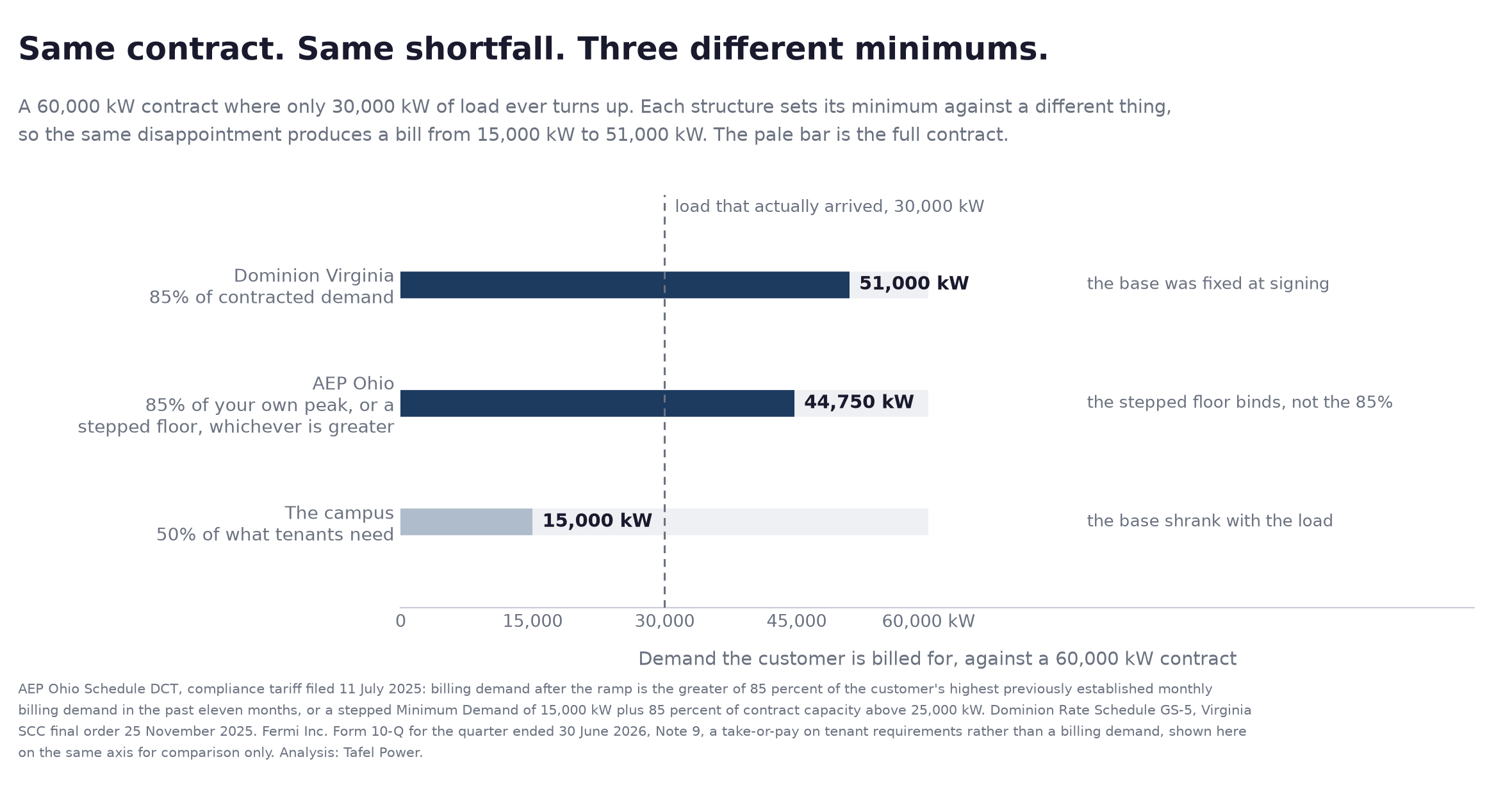
Same contract. Same shortfall. Three bills, from 15,000 kW to 51,000 kW.
Two of these percentages shrank with the customer. Only one of the bills did.
The rest of the comparison
| The Fermi campus | AEP Ohio | Dominion Virginia | Entergy Louisiana | |
|---|---|---|---|---|
| The minimum, and of what | 50 percent or more of what tenants need | 85 percent of your own past peak, or a stepped floor against contract capacity, whichever is greater | 85 percent of contracted demand for wires, 60 percent for generation | Not published |
| What backs it | This minimum is the take-or-pay to the generator, and what backs it is a guarantee capped at twelve months of capacity charges. The lease carries its own guaranties, both ways, with no amounts published | Guarantee or collateral at signing, half the full-term minimums | Required, amount not read for this piece | Not published |
| Cost to leave | Not published | Minimums for the rest of the term | Minimums for the rest of the term | Named, no number |
One row in that table runs the other way. Ohio and Virginia publish a ratchet, a term and an exit fee, and neither publishes a cap on anything. Louisiana names every instrument it uses and publishes what none of them is worth. The ceiling in the backing row is the only one anybody disclosed, and it is the private deal that disclosed it.
What this means for the next one
The next large tenant will be quoted a price per megawatt-hour, and that price will be compared to other prices.
Underneath it sits a minimum, and the minimum is only as good as the thing it counts. A base fixed at signing is still there when the load is not. A base that tracks what the customer actually did, or what its tenants actually need, goes away exactly when it is needed.
Neither of those facts shows up in the rate, and both of them show up in the bill.
Where the fuel and the exit terms sit is in Who Holds the Fuel Risk?. Every source, with the full ledger, is in the record.
Questions, corrections or disagreement on any of this are welcome: kris@tafelpower.com
More from Insights
August 15, 2026
Large-Load Power Contracts: The Record
Four structures, read from the tariffs, the commission orders and the filings. Facts and sources only. The arguments are in the two briefs this supports.
August 9, 2026
The Data Center Buildout Has a Toilet Paper Problem
GE Vernova has more gas turbine capacity reserved than sold: 63 GW of held production slots against 53 GW of signed orders. Holding a slot is not the same as buying a turbine, and that difference is what the headline number hides.