Who Holds the Fuel Risk?
Gas moved by $39 to $59 a megawatt-hour over three years. Where that lands is a drafting choice, not a market fact.
For infra funds · For developers · For utilities · For hyperscalers · large-load · project-economics · capital · procurement
Kris Narayanan · Tafel Power · August 16, 2026 · 3 min read
Here is that swing, machine by machine, at the Henry Hub prices the market actually printed between August 2023 and July 2026.
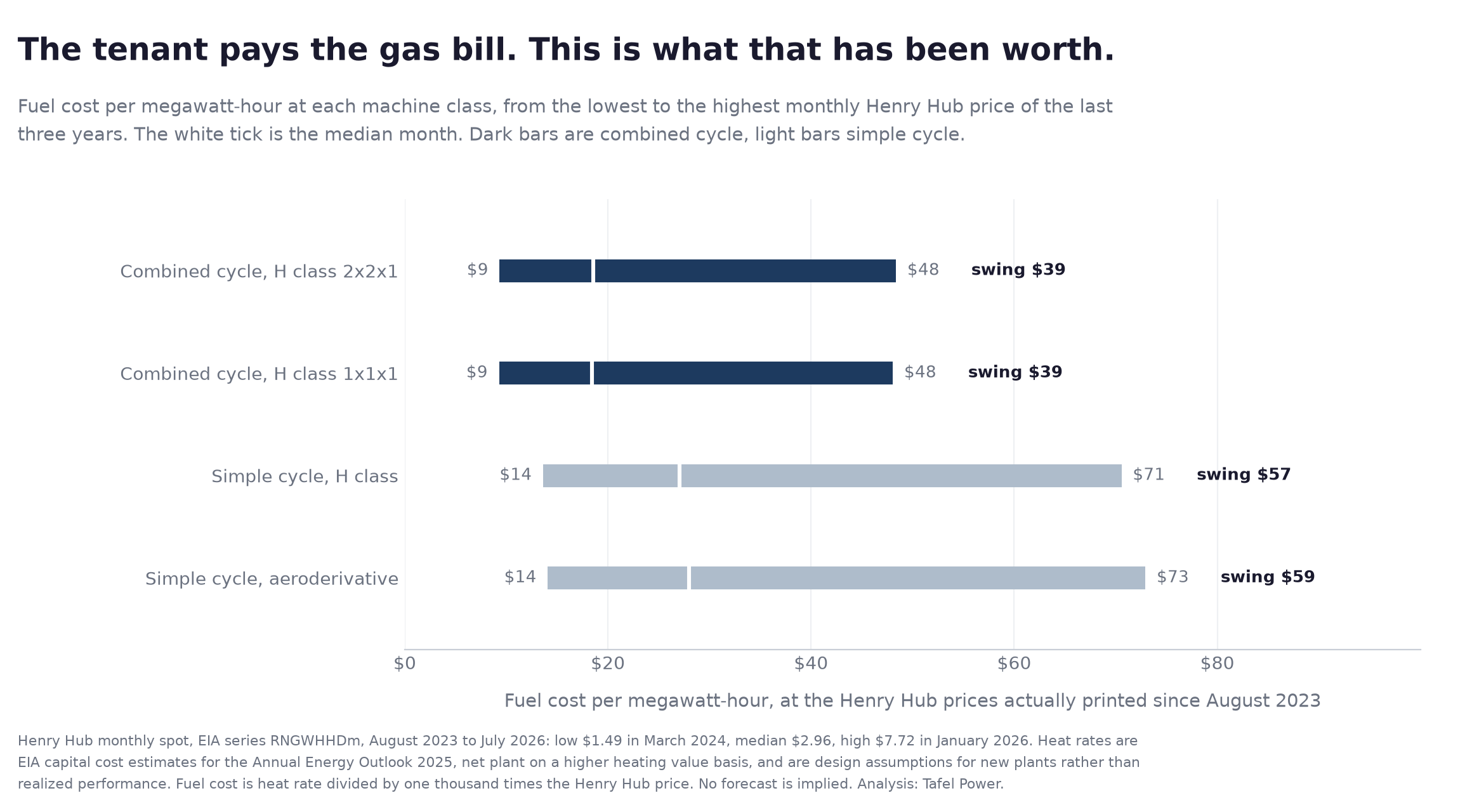
Nobody gets to swap machines month to month. You buy one and you ride its whole bar. So the only question that matters is who is holding it.
That is not a market fact. It is a drafting choice, and the four structures read here made it four different ways. One of the four is that nobody published an answer.
Virginia put it in the tariff
Dominion's data center schedule was approved by the Virginia commission in November 2025. It covers generation, and sets a minimum generation charge at 60 percent of contracted demand alongside 85 percent for distribution and transmission.
So the generation sits inside the regulated relationship, not in a separate commercial contract. How much of a gas move reaches the customer, and how fast, depends on a recovery mechanism this brief did not extract.
Ohio left it out of the tariff entirely
AEP Ohio's data center schedule looks like the same instrument. It is not, because of what it covers.
Schedule DCT applies to electric distribution service. Its demand charges are distribution demand charges. Customers under it buy their actual electricity somewhere else, either from the default standard service offer or from a competitive retail supplier they choose.
So the eighty-five percent ratchet everyone quotes secures the wires. The fuel is in a different contract, with a different counterparty, on different terms, and the tariff never reaches it. Read Ohio's schedule end to end and you have not learned who holds the gas.
The campus passed it to the tenant
Fermi's campus in the Texas Panhandle will buy its power from a generator building on site. Under a framework agreement entered August 11, 2026, Fermi will buy capacity at a fixed charge with gas costs treated as a pass-through. That capacity charge is passed through again, to Fermi's tenants. Management said the same of the fuel on August 13: "fuel costs are passed through to the tenant as well."
The tenant holds the whole bar. The tenant also chose neither the machine nor the gas contract, and the machine is what sets the width of the bar. A simple-cycle aeroderivative swings $59 where a combined cycle swings $39, and that difference was decided by whoever bought the turbines.
And Louisiana did not say
The Louisiana commission approved a settlement for a large customer in August 2025. The order names the instruments it used: an electric service agreement, contribution in aid of construction agreements, parent guaranties, credit insurance and collateral, and an early termination fee.
It publishes no magnitude for any of them, and it does not say where the fuel sits. The utility did not seek approval of the agreements themselves. From outside the case there is no way to tell.
What to take from it
Two of those four answers are not in the document you would be handed first.
| Where the fuel sits | |
|---|---|
| Dominion Virginia | Inside the tariff. Recovery mechanism not extracted |
| AEP Ohio | Outside it. The schedule covers distribution service only |
| The Fermi campus | With the tenant, by pass-through |
| Entergy Louisiana | Not published |
A price per megawatt-hour tells you none of this. Before comparing one price to another, find out which document the fuel lives in. In half of these it is not the one in front of you.
The four structures read in full, with the ledger of every instrument and all sources, are in the record. The companion brief on what these contracts set their minimums against is Fifty Percent of What?.
Questions, corrections or disagreement on any of this are welcome: kris@tafelpower.com
More from Insights
August 16, 2026
Fifty Percent of What?
Every large-load power deal sets a minimum the customer owes whether or not it draws. Everyone compares the percentage. What the percentage is a percentage of is what decides whether it protects anyone.
August 15, 2026
Large-Load Power Contracts: The Record
Four structures, read from the tariffs, the commission orders and the filings. Facts and sources only. The arguments are in the two briefs this supports.