Large-Load Power Contracts: The Record
Four structures, read from the tariffs, the commission orders and the filings. Facts and sources only. The arguments are in the two briefs this supports.
For infra funds · For developers · For utilities · For hyperscalers · large-load · project-economics · capital · procurement
Kris Narayanan · Tafel Power · August 15, 2026 · 15 min read
Facts and sources for Who Holds the Fuel Risk? and Fifty Percent of What?. Nothing here argues anything.
Start here: the seven questions
| Question | What the four structures show |
|---|---|
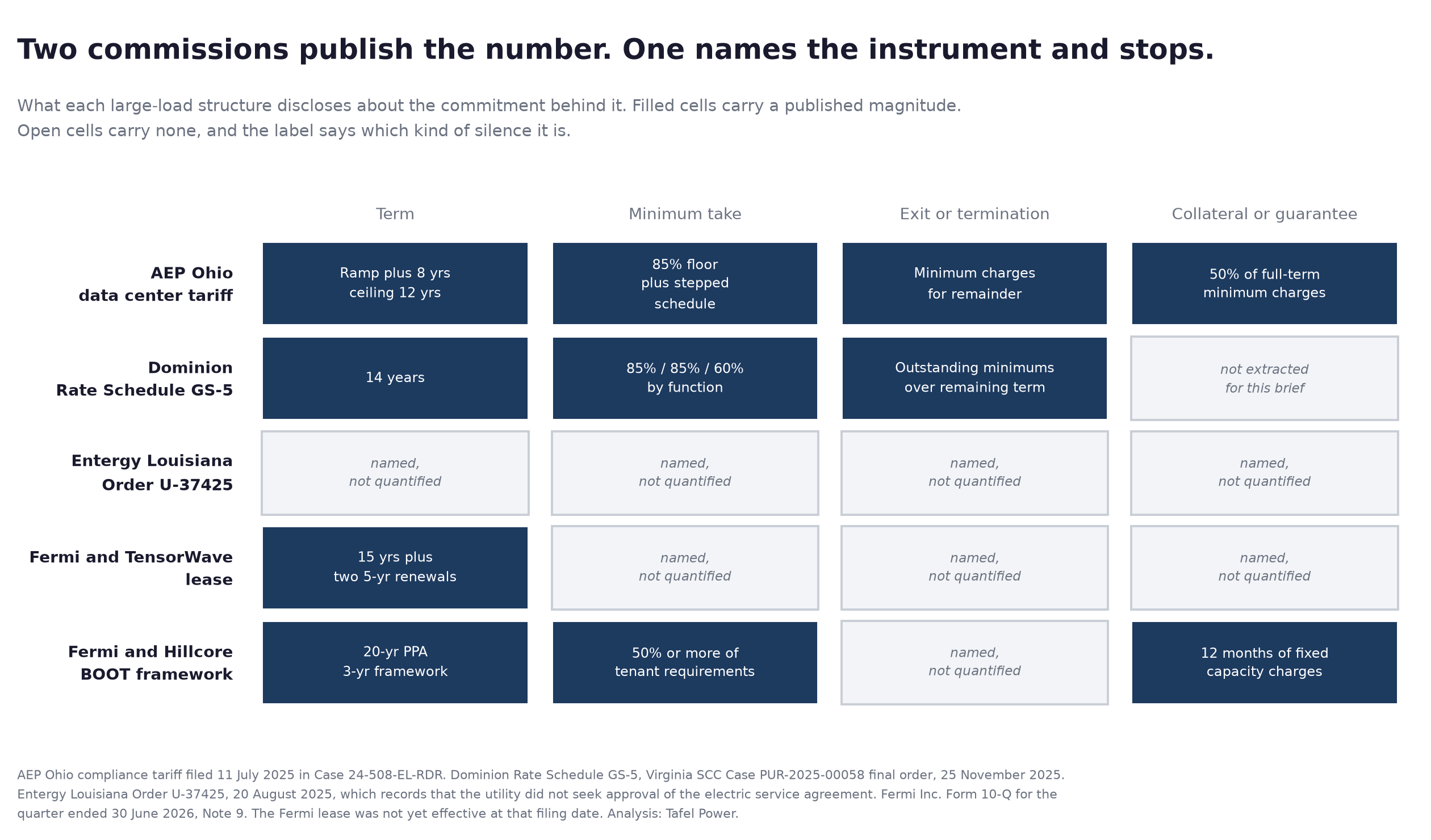
| What percentage is take or pay? | What it is struck against matters more than the number. Ohio: 85 percent of the customer's own highest monthly billing demand in the past eleven months, with a stepped floor beneath it set against contract capacity. Virginia: 85 percent of contracted demand for wires, 60 percent for generation. Campus: 50 percent or more of aggregate tenant requirements. Louisiana: no percentage published, and no minimum take among the instruments named. |
| How long is the term? | Ohio: ramp plus eight years, twelve-year ceiling. Virginia: fourteen years, and the minimum charges continue past the term if service continues. Campus: fifteen years plus two five-year renewals. Fermi describes a twenty-year power purchase agreement at campus level, renewable in ten-year increments, which is a company statement rather than a filing term. |
| Who owns gas price risk? | Campus: passed to the tenant. Ohio: outside the schedule entirely, which covers distribution service, so supply sits in a separate contract. Virginia: generation is inside the schedule, but the fuel adjustment mechanism was not extracted here. Louisiana: not disclosed. |
| What credit support is required? | Ohio: 50 percent of full-term minimum charges at signing. Campus: a parent guaranty from the tenant, an obligations guaranty and a completion guaranty from the landlord, none with a disclosed amount. The twelve-month cap is not tenant credit support. It sits one level up, where the offtaker guarantees capacity payments to the generator, and it is the only published ceiling in this sample. |
| What happens if only 250 MW shows up? | Virginia: charges it directly, because its minimums are struck against contracted demand. Ohio: the 85 percent ratchet follows the customer's peak down and does not catch it. The stepped Minimum Demand does, because it is set against total contract capacity. Campus: neither, because the take-or-pay is a percentage of aggregate tenant requirements. A floor written against the tenants who sign does not protect against the tenants who do not. |
| What happens if the tenant exits in year 7? | Ohio: minimum charges for the remainder of the term. Virginia: outstanding minimums over the remaining term. Louisiana: the termination fee mechanics are named, no figure published. Campus: the lease's power charges have no published magnitudes, so the exit cannot be priced from outside. |
| What has to be signed before lenders release construction capital? | The tariffs do not answer this and the filings do. On the turbine warehouse facility, the step-down in required amortization depends on a signed lease or offtake covering at least 400 MW of phase one by November 10, 2026. A separate facility triggers a mandatory prepayment if no approved customer agreement arrives by December 31, 2026. The lease on the table covers 222 MW. |
The two published schedules
| AEP Ohio | Dominion Virginia | |
|---|---|---|
| Instrument | Schedule DCT, the data center tariff, compliance schedule filed July 11, 2025 under the Opinion and Order of July 9, 2025 | Rate Schedule GS-5, Final Order in Case No. PUR-2025-00058, November 25, 2025, effective January 1, 2027 |
| Threshold | Monthly maximum demand greater than 25,000 kW within the initial contract term | Two conditions, both required: measured or contracted demand of 25 MW or greater on a contiguous site, and measured or expected load factor of at least 75 percent |
| Term | Not less than the load ramp period plus 8 years. Maximum contract term including the ramp is 12 years | 14 years, for customers signing on or after January 1, 2027 |
| Ramp | Load ramp period, with billing demand during the ramp not less than 85 percent of load ramp contract capacity | Optional ramp within the term, not exceeding four years, minimum annual ramp of 20 percent |
| Minimum take | After the ramp, billing demand not less than the greater of 85 percent of the customer's highest previously established monthly billing demand over the past eleven months, or a stepped minimum demand schedule. For 25,001 kW to 75,000 kW that step is 15,000 kW plus 85 percent of the amount above 25,000 kW, and minimum demand never exceeds 85 percent of total contract capacity | Minimum distribution charge 85 percent of contracted demand, minimum transmission charge 85 percent, minimum generation charge 60 percent |
| Exit | Customer remains responsible for minimum charges regardless of use. After the ramp the customer may instead pay an exit fee equal to minimum charges for the remainder | Exit fee covering outstanding minimum charges over the remaining contract duration, subject to capacity reassignment |
| Collateral | Guarantee or collateral at signing equal to 50 percent of total minimum charges for the full term | Not extracted for this brief |
The Fermi campus
| Lease | Entered August 9, 2026 between Fermi Campus 1 LLC as landlord and TensorWave TEX1, LLC as tenant. A modified net lease |
| Capacity | 222 MW of total facility power following commencement of the final delivery phase. An expansion option for two additional buildings would reach 650 MW |
| Term | Fifteen years from that commencement, with two renewal options of five years each |
| Power charges | The tenant pays base rent and, "as additional rent," fixed and variable power charges and certain taxes. No magnitude, escalation or calculation method is published anywhere |
| Effectiveness | Not yet effective at the filing date. Conditions include board approvals and the landlord obtaining project-level financing. Closing expected on or before September 30, 2026, subject to extension. Either party may terminate if conditions are not satisfied, and the filing states there can be no assurance the lease will commence |
| Guaranties | TensorWave Inc. guarantees the tenant's obligations. Fermi provides a guaranty of the landlord's obligations and a completion guaranty supporting construction |
| Backstop | A backstop agreement supporting certain obligations under the lease, described on August 13, 2026 as being finalized with the counterparty to be identified later |
| Generation | Framework agreement entered August 11, 2026 with Hillcore Energy Capital Corporation, an Alberta company. Hillcore finances, constructs, owns and operates gas-fired generation, solar and storage on roughly 400 acres under a build-own-operate-transfer structure, with Fermi as anchor offtaker |
| Offtake | Fermi purchases capacity on a take-or-pay basis at 50 percent or more of the aggregate power requirements of all tenants, at a fixed capacity charge, with gas costs treated as a pass-through. The fixed capacity charge is itself passed through to tenants |
| Going concern | In the same filing, under the going concern standard, Fermi identified that it had not generated revenues, had incurred recurring losses and negative operating cash flows since inception, and that its resources were not sufficient to satisfy its obligations as they become due within one year. It described the plans it had approved to alleviate the resulting substantial doubt, including undrawn committed capacity under its equipment financing facilities and sequencing capital expenditure against definitive tenant agreements, and concluded that it is probable those plans will be effectively implemented within twelve months. |
The Entergy Louisiana order
| Order | No. U-37425, Louisiana Public Service Commission, decided August 20, 2025 |
| Settling parties | The utility, Staff, Sierra Club, Walmart and the Southern Renewable Energy Association |
| Instruments named | An Electric Service Agreement, Contribution in Aid of Construction agreements, Parent Guaranty agreements, credit insurance and other collateral security, and an Early Termination Fee |
| Magnitudes published | None. No term length, no minimum bill, no collateral amount, no termination fee figure |
| On termination | The utility "will prudently seek to maximize the value of any excess capacity" and, after receiving the Early Termination Fee, must file for Commission approval of how it proposes to use it |
| Reporting | The utility must report the customer's renewal status during the original term |
| Transmission | Upgrades required solely because of the project "will not be included in the rates of customers other than the Customer" |
| Approval | The utility "did not seek approval of the ESA and Related Agreements." Staff "explicitly is not expressing approval of, or recommending that the Commission approve" them |
Every instrument, by direction
Customer to utility
| Instrument | Who pays | Who is protected | What caps it |
|---|---|---|---|
| AEP Ohio minimum charges, distribution service only | Customer | Utility and its other ratepayers | 85 percent floor on billing demand, or the stepped schedule, whichever is greater |
| AEP Ohio collateral | Customer | Utility | 50 percent of total minimum charges for the full term, posted at signing |
| AEP Ohio exit fee | Customer | Utility | Minimum charges for the remaining term |
| Dominion minimum charges | Customer | Utility and its other ratepayers | 85 percent distribution, 85 percent transmission, 60 percent generation. No end date if service continues past the term |
| Dominion exit fee | Customer | Utility | Outstanding minimum charges over the remaining duration, reduced by capacity reassignment |
| Entergy Louisiana ESA and related agreements | Customer, presumed | Utility and its other ratepayers, presumed | Not disclosed. Instruments named, magnitudes withheld, and approval of the agreements was not sought |
| Entergy Louisiana transmission cost allocation | Customer | Other ratepayers | Upgrades required solely for the project are excluded from other customers' rates |
Tenant and landlord, both directions
| Instrument | Who pays | Who is protected | What caps it |
|---|---|---|---|
| TensorWave lease, tenant obligations | TensorWave | Fermi | Parent guaranty from TensorWave Inc. Amount not disclosed |
| TensorWave lease, landlord obligations | Fermi | TensorWave | Landlord guaranty and a completion guaranty. Amounts not disclosed |
| TensorWave lease, backstop | Third party | Not stated | Being finalized as of August 13, 2026, counterparty unnamed by Fermi |
Offtaker and generator
| Instrument | Who pays | Who is protected | What caps it |
|---|---|---|---|
| Hillcore capacity payments | Fermi, passed to tenants | Hillcore | Guarantee of the payment obligations capped at twelve months of fixed capacity charges then payable |
| Hillcore fuel | Tenant | Fermi and Hillcore | Pass-through. No cap disclosed |
| Hillcore construction and performance | Hillcore | Fermi | Hillcore finances, builds, owns and operates. First block of approximately 360 MW to be built without any condition that tenant power purchase arrangements be signed first |
Lenders and equipment counterparties to the developer
| Instrument | Who pays | Who is protected | What caps it |
|---|---|---|---|
| MUFG turbine facility | Fermi subsidiary | MUFG | Absent a signed lease or offtake for at least 400 MW of phase one by the nine-month anniversary of February 10, 2026, the agent may begin marketing the equipment, but may not sell or foreclose absent an event of default |
| Keystone high voltage facility | Fermi subsidiary | Keystone | Mandatory prepayment if an approved customer agreement has not been received by December 31, 2026, a minimum liquidity covenant, and a collateral coverage test at 110 percent of fair market value |
| Texas Tech ground lease | Fermi | Texas Tech University System | Notice to proceed required by December 31, 2026, conditioned on a phase one tenant of not less than 200 MW, and TTU may terminate if it is not received |
| Siemens rated capacity agreement | Fermi | Siemens | Per-turbine quarterly payment tied to operating reliability, with a floor, for ten years, capped at approximately $240.0 million undiscounted |
| Net profits interest | Fermi | Equipment seller | A portion of 2.5 percent of net operating income from the first 1.0 GW of installed dispatchable capacity, capped at $100 million on a net present value basis |
Methodology and sources
Only needed if you are checking a figure. Everything above stands on the documents named here.
Everything quantitative here is read from a public primary document. Where a company and its own filing describe the same arrangement differently, the filing governs and the difference is reported rather than reconciled.
Fermi Inc. Form 10-Q for the quarter ended June 30, 2026, filed August 14, 2026, accession 0002071778-26-000051. The TensorWave lease, its 222 MW, the fifteen-year initial term and two five-year renewals, the 650 MW expansion option, the parent, landlord and completion guaranties, and the closing conditions and September 30, 2026 closing date are all Note 9, Subsequent Events. The Hillcore framework agreement, the 50 percent take-or-pay floor, the fixed capacity charge and its pass-through to tenants, the twelve-month guarantee cap, the approximately 360 MW first block, the three-year initial term, the exclusivity and the fair market value purchase option are also Note 9. The condition, plans and conclusion described in the campus section above are Note 2. The MUFG turbine warehouse facility, its nine-month step-down test at 400 MW and the agent's marketing remedy, and the Keystone facility with its December 31, 2026 prepayment trigger, minimum liquidity covenant and 110 percent collateral coverage, are Note 5. The Texas Tech ground lease, its December 31, 2026 notice to proceed and the 200 MW phase one condition are Note 6. The Siemens rated capacity agreement and the net profits interest are Note 8. The net profits interest is a portion of 2.5 percent of net operating income from the first 1.0 GW of installed dispatchable capacity, capped at $100 million on a net present value basis, and became a related-party arrangement in July 2026.
A units note that matters. Fermi's condensed financial statements are stated in thousands. The Siemens agreement appears in Note 8 as "up to $2,000 per turbine per calendar quarter" with a cap of "approximately $240,000," and in the same document's management discussion as "$2 million per turbine" with a cap of "approximately $240.0 million." Both describe one obligation. Every Fermi figure in this brief uses the management discussion convention.
Company statements, dated. Fermi's earnings release and investor presentation were furnished on Form 8-K on August 13, 2026, accession 0002071778-26-000046. The prepared remarks of the same date were published at investor.fermiamerica.com. The 200 MW Xcel Energy grid tie, the 220,000 MMBtu per day of firm supply, the twenty-year power purchase agreement renewable in ten-year increments, the year-ten purchase option and the characterization that construction, operating and performance risk sits with Hillcore are company statements from those documents, not filing terms.
Two places where the company and the filing differ. Fermi calls the TensorWave lease binding; the 10-Q says its effectiveness is subject to closing conditions and that there can be no assurance it will commence. The investor presentation puts Hillcore's first power at approximately 350 MW; Note 9 says approximately 360 MW, one day apart. This brief uses the filing in both and does not average them. A third pair only looks like a difference: the prepared remarks say Fermi commits as tenant leases are signed, and Note 9 sets the take-or-pay at 50 percent or more of aggregate tenant requirements. With no tenants that floor is zero, so the filing states the formula and the remarks state the principle.
AEP Ohio. Schedule DCT, the compliance tariff filed July 11, 2025 in accordance with the Commission's Opinion and Order of July 9, 2025. The docket appears under two suffixes in the same document: the transmittal letter cites Case No. 24-508-EL-RDR and the tariff sheet cites Case No. 24-508-EL-ATA, so this brief cites the order by date. The schedule applies to electric distribution service, and customers under it take supply from the standard service offer or a competitive retail supplier, so generation is outside it. The 25,000 kW threshold, the load ramp period, the 85 percent floors, the contract term of not less than the ramp plus eight years with a twelve-year ceiling, the exit fee and the collateral at 50 percent of full-term minimum charges are read from that schedule. The stepped minimum demand schedule is read from the same document: for the band from 25,001 kW to 75,000 kW the minimum is 15,000 kW plus 85 percent of the amount above 25,000 kW, and minimum demand never exceeds 85 percent of total contract capacity. The twelve years is a ceiling on ramp plus term and is not the contract term.
Dominion. Case No. PUR-2025-00058, Final Order of the Virginia State Corporation Commission, November 25, 2025. Rate Schedule GS-5 and its two eligibility conditions at page 23, the fourteen year term, the four-year ramp at a 20 percent minimum annual step and the exit fee at page 24, and the 85 percent distribution, 85 percent transmission and 60 percent generation minimums at page 25. The provision that minimum charges continue if service continues past the term is at page 24. A later Virginia proceeding, Case No. PUR-2026-00056, Final Order of July 31, 2026, discusses allocation methodology and refers to the 85 percent transmission minimum as already adopted; it does not modify the GS-5 terms used here.
Entergy Louisiana. Order No. U-37425 of the Louisiana Public Service Commission, decided August 20, 2025, approving a settlement among the utility, Staff, Sierra Club, Walmart and the Southern Renewable Energy Association. The instruments named above, the early termination fee mechanics, the renewal status reporting obligation and the transmission cost exclusion are read from that order. No term length, minimum bill, collateral amount or termination fee figure appears in it. The order records that the utility did not seek approval of the electric service agreement and related agreements, and that Staff did not express approval of them. Two later dockets are context only: U-37882, a procedural order of April 15, 2026 setting a November 2026 consideration date, and the Commission's large load additions guidelines, which are non-binding.
Fuel. Henry Hub monthly spot prices are EIA series RNGWHHDm. The window is the trailing thirty-six months, August 2023 through July 2026, with a low of $1.49 in March 2024, a median of $2.96, a mean of $3.01 and a high of $7.72 in January 2026. Heat rates are EIA's capital cost estimates for the Annual Energy Outlook 2025: 6,266 Btu/kWh for a 2x2x1 H-class combined cycle at 1,227 MW net, 6,226 for a 1x1x1 single shaft H-class at 627 MW net, 9,142 for an H-class combustion turbine and 9,447 for a four-unit aeroderivative class plant, all net plant on a higher heating value basis. Those are design assumptions for new plants, not realized fleet performance. Fuel cost per MWh is heat rate divided by one thousand times the Henry Hub price. Every dollar figure in the fuel cost table is computed that way from the two inputs above and appears in no source document. No forward curve is used and no forecast is implied.
Permian basis is excluded on purpose. EIA's own Waha coverage attributes its price data to a commercial source rather than publishing a Waha series, so no Waha figure appears anywhere in this brief. EIA's note of September 10, 2024 observes that when production growth outpaces pipeline additions, prices at the Waha hub decline sharply, and that added takeaway capacity should help raise them. That statement is used qualitatively and nothing is built on it.
What was searched for and not found. Three terms this brief expected to compare are not in any public source: the escalation on the fixed power charge, the definition of the variable power charge, and any per megawatt comparable for the campus build. Note 9, the earnings release, the investor presentation and the prepared remarks were each searched in full. Note 9 discloses that those charges exist and nothing about their size. So no fixed share of the campus power bill is computed here, and none is compared to the utility rows. The backstop agreement is reported exactly as management described it and nothing further.
Exclusions. No executive is named and no motive is attributed. Southwestern Public Service is not treated as a tariff comparison row, because no filed large-load schedule for it was located; the 200 MW grid tie appears only as part of the campus supply. Rate components for the AEP Ohio and Dominion schedules were not extracted, so this brief compares commitment structures rather than delivered prices.
All analysis by Tafel Power from public sources.
Questions, corrections or disagreement on any of this are welcome: kris@tafelpower.com
More from Insights
August 9, 2026
The Data Center Buildout Has a Toilet Paper Problem
GE Vernova has more gas turbine capacity reserved than sold: 63 GW of held production slots against 53 GW of signed orders. Holding a slot is not the same as buying a turbine, and that difference is what the headline number hides.
August 6, 2026
Gas Turbines Are Scarce. The Turbine Maker Reports a Thinner Margin.
What every part of the data center power supply chain actually reports, from utilities to software. The turbine maker, holding the acknowledged bottleneck, reports 18.8 percent on an EBITDA basis, against 27.5 percent operating at Eaton. Four parts of the chain disclose no separable return at all.