The Hidden Clocks of Power
Twelve months in, revenue is below plan. That number fits a bad offer, bad execution, a strategy that is simply early, and one the company cannot afford. Nothing in the data separates them.
For developers · For infra funds · For utilities · For hyperscalers · project-economics · procurement · capital · large-load
Kris Narayanan · Tafel Power · September 16, 2026 · 6 min read
You take your company into a new utility market. You hire salespeople, sign channel partners and start the long qualification process.
Twelve months later revenue is below plan and the CFO asks the obvious question: how much longer are we funding this?
There are four explanations, and the revenue line cannot tell them apart.
- Wrong offer. Customers do not want this. Stopping is right.
- Wrong execution. The offer is right and the way you are selling it is not. People, coverage, channel, sales motion. That is a thing to fix, not a reason to leave.
- Wrong clock. Offer and execution are both working. It needs four years and you are being judged at one.
- Wrong balance sheet. All of it works, in seven years. The company can fund three.
You have to decide before you know which is true. That is a leadership problem, not a data problem.
Two questions tell you what kind of decision you face
How long until we know, and what do we lose if we stop.
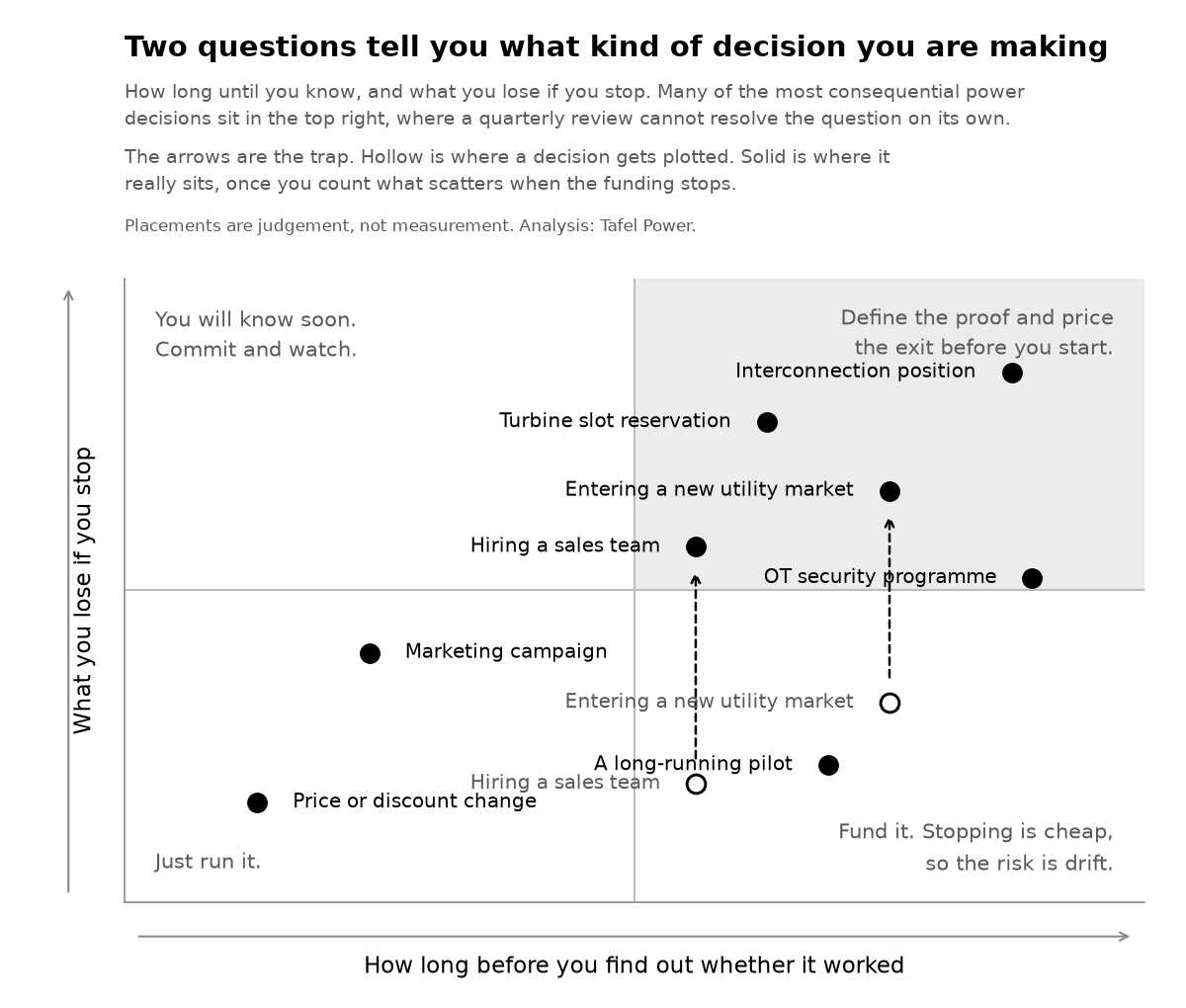
Price changes and campaigns sit bottom left, fast to resolve and cheap to stop. A long-running pilot sits bottom right, slow but cheap to stop. Turbine slot reservations and interconnection positions sit top right, with an operational technology security programme just inside the same quadrant. Hiring a sales team and entering a new utility market appear twice: hollow where they get plotted, solid where they belong.
Much of the power business lives in the top right, where a quarterly review cannot settle the question.
Your market entry sits further up and to the right than your budget review suggests. The saving shows up on a budget line. The qualifications, the relationships and the market knowledge that scatter when the funding stops show up on no line at all, and that is usually the bigger number.
Why this is hard to see from inside is well studied. When a long gap separates a decision from its result, learning slows sharply, because the lesson arrives after the decision that needed it.1 I studied this at MIT Sloan and it is still hard to spot in a live business. Boards meet quarterly. Utility sales cycles run years. Equipment and transmission run longer. In that room the fastest clock wins, because it has the freshest numbers.
Four questions govern the decision
Know the clock. First ask whose clock it is. A sales cycle can sometimes be shortened. A merchant power price cycle cannot: you can land the site, the equipment and the interconnection on schedule and still wait years for the signal that justifies the asset. What changes that is converting a market clock into a contract clock, which is the real case for a long dated offtake. You are not buying a better price, you are buying a clock you can plan against. A regulated counterparty runs on a different clock again, because capital in rate base earns a return for decades while an operating saving is reset at the next rate case.2 Before trying to accelerate a result, establish whether the delay is yours to manage.
Define the proof. What must accumulate, to what level and by when, and what must convert? A growing pipeline with flat conversion is not progress, and where it stalls narrows the diagnosis.
- Little qualification suggests an offer, targeting or access problem.
- Qualification without specification suggests product fit or execution.
- Specification without orders suggests price, terms, competition, procurement or timing.
- Healthy conversion at every stage but slower than expected suggests the clock.
- Work accumulating behind one stage suggests a capacity constraint, and adding opportunities may make it worse.
Narrows, not proves. The funnel tells you where to look rather than what you will find. And the fourth explanation does not appear in it at all: a strategy that is right but early and one that is right but unaffordable produce the same commercial evidence. That answer comes off the financial clock, which is why funding the wait has to be its own question.
Fund the wait. How much will we spend before the evidence has to arrive? A number, agreed at the start.
Price the exit. If we stop, what is hard to recover?
Answer them before the investment starts, not in the meeting where people are already defending it or trying to kill it. The rest of this is why each one earns its place.
Stage totals are not interchangeable
GE Vernova's second quarter 2026 gas headline was 116 GW, which hides 53 GW of equipment backlog and 63 GW of slot reservations. Net the quarter and backlog grew 44 to 53 while reservations grew 56 to 63, so the committed stage grew faster.3 That is a healthy funnel. ERCOT shows the same shape at system scale.4
| Stage | GW |
|---|---|
| Applications through 2033 | 445.8 |
| No studies submitted | 321.0 |
| Under ERCOT review | 93.7 |
| Met the Section 9.5 requirements | 22.0 |
| Approved to energize, not yet operational | 3.2 |
| Energized and observed | 5.9 |
Source: ERCOT Monthly Operational Overview, April 2026.
Every figure is correct and only the last is load.
Stocks tell you what has accumulated. Conversion tells you whether it is moving. A headline gives you neither, which is why defining the proof means naming a conversion and not just a total.
The exit that happens without a decision
Nobody stops a security programme. The budget stays flat while coverage grows, an upgrade slips a year and then again, a role stays open because the business case is hard to write. Each is defensible. Together they raise exposure, and no meeting ever decided to accept it.
Sales looks unsuccessful because revenue has not arrived. Security looks unnecessary because the incident has not arrived. Both are timing errors, and the second shows that an exit can be paid for in instalments by people who never thought they were exiting.
A test you can actually fail
Any weak team can say the market needs another year. If every accumulating activity counts as progress, the strategy can never fail. That is not systems thinking, it is rationalisation.
We built a screen at Tafel Power to predict which interconnection projects would complete, and registered the test before building the model. It failed. Completion ran around 17 percent in every tier and the factors we expected to matter did not. We could have moved the thresholds until it looked right, which would have fixed the model and destroyed the test. We deleted it. That is testimony rather than a citation, offered because the argument is worth less if I only recommend the discipline to other people.
Define the evidence before you know whether you will like the answer.
Patience needs a budget
Two clocks run at once. The commercial clock builds relationships, qualifications and orders. The financial clock burns cash. If the financial clock hits zero first, it does not matter that the strategy would eventually have worked.
Patience is waiting. Strategic patience is funding a defined period of learning. It needs a budget, the evidence that should appear before revenue does, and a point where you will say the evidence did not arrive. Otherwise patience becomes drift.
Stopping does not put you back where you started either. A sales team can be rehired, but some things do not come back on the same terms: a surrendered manufacturing slot where the replacement is years out, a lapsed qualification, a specialist who leaves with the account history. Capital left in a weak strategy has its own cost, because it cannot be used somewhere better. The trade is between the cost of continuing when you are wrong and the cost of stopping when you are right, and those are rarely equal.
Back to the decision
None of this argues for waiting longer. Sometimes low revenue means the strategy is bad, sometimes a large pipeline is mostly noise, and sometimes the right answer is to stop early.
At month twelve you still cannot tell which of the four explanations is true, and by the time the data settles it the decision will have been made for you. What you could have done is fix the terms before the first hire: how long the qualification cycle actually runs and whether that clock is yours, what should have accumulated and converted by month twelve, how much the company would spend before the evidence had to arrive, and what you would lose that you could not buy back.
That is the whole discipline, and it is only available in advance.
Know the clock. Define the proof. Fund the wait. Price the exit.
Footnotes
-
Hazhir Rahmandad, Nelson Repenning and John Sterman, "Effects of feedback delay on learning," System Dynamics Review 25, no. 4 (2009): 309-338. doi:10.1002/sdr.427 ↩
-
The nineteen-utility dataset behind this is at Tafel Power, "How a Utility Gets Paid," 16 September 2026. https://tafelpower.com/insights/how-a-utility-gets-paid ↩
-
GE Vernova Inc., second quarter 2026 earnings release, filed as an exhibit to Form 8-K on 22 July 2026. https://www.sec.gov/Archives/edgar/data/1996810/000199681026000147/gevpressrelease2q26.htm ↩
-
ERCOT Monthly Operational Overview, April 2026. https://www.ercot.com/files/docs/2026/05/13/ERCOT-Monthly-April-2026-FINAL.pdf ↩
Questions, corrections or disagreement on any of this are welcome: kris@tafelpower.com
More from Insights
September 13, 2026
Batteries, Generators, or Demand Response? What the Tariff Measures Decides
Transmission exposure runs from one peak hour a year to every megawatt hour consumed. The shape of what gets measured decides which instrument can reach it, and sometimes none of them can.
September 11, 2026
A Texas Power Plan Can Cost 9.8 Cents. Or 22.2.
Across the 57 plans priced this way, that is the median at 1,000 kWh against the median at 500. The difference is how much you use that month. I downloaded all 1,053 plans on the state's Power to Choose site to find out how common this is.