The Large-Load Financial Security Just Got Cut in Half
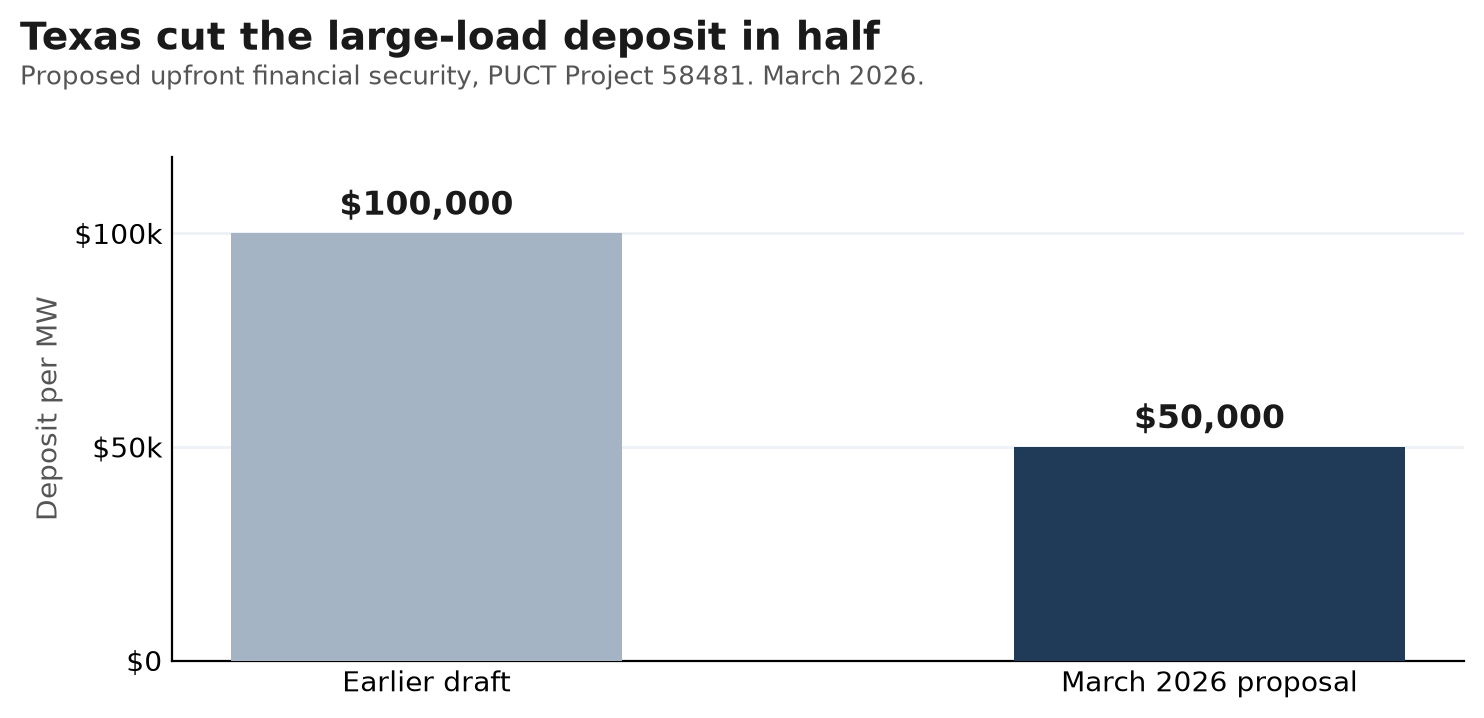
For developers and large power buyers: Texas proposed cutting the upfront security from $100,000 to $50,000 per megawatt.
For developers · For hyperscalers · ercot · puct · batch-zero · large-load · financial-security
Kris Narayanan · Tafel Power · March 20, 2026 · 1 min read
Superseded by the July 2026 Batch Zero update. See the current Batch Zero note for the operative interim framework.
Texas makes big power users post cash to prove they are serious before they can tie up the grid. In March 2026 that number moved.
What changed
The Public Utility Commission released its proposal for the large-load rule, Project 58481. It set the default upfront security at $50,000 per megawatt. The earlier draft had it at $100,000. So the number dropped by half.
This is a proposal, not the final rule
The March version is a draft the commission put out for comment. It is not law yet. The final rule is expected later in 2026. At the time of publication, an interim step called Batch Zero was still in development, expected to let large loads move ahead using the same $50,000 per MW default.
What it means
For a large power buyer, less cash is tied up at the start. A 1,000 MW load would post $50 million under the default, down from $100 million.
For a developer, the financial security still does its job. It pushes out large-load requests that were holding a spot with no real money behind them, which makes the large-load pipeline easier to read.
The $50,000 per MW is described as a default rate. Where the specific grid upgrade costs can be determined, the security may track those costs instead.
Methodology
Based on PUCT Project 58481 and its March 2026 proposal for publication. The $100,000 and $50,000 per MW figures come from the public docket. The rule is a proposal and may change before it is final. All data compiled by Tafel Power from public sources. Framing informed by the firm's transaction advisory work in ERCOT and cross-ISO markets.
Questions, corrections or disagreement on any of this are welcome: kris@tafelpower.com
More from Insights
February 18, 2026
The ERCOT Queue Has Fewer, Bigger Projects
For developers and infra funds: the project count fell through late 2025 while total requested capacity rose, so the average project is larger.
January 15, 2026
Gas, Not Renewables, Is Driving ERCOT's Queue Growth
For developers and large power buyers: the queue total keeps rising, but nearly every new gigawatt is a single fuel.