The Reciprocal Commitment Ladder: How Scarcity Determines Who Commits First
The right commitment structure is not universal. It depends on which side has alternatives, which inputs are scarce, and how much unrecoverable exposure each milestone creates.
For hyperscalers · For developers · For infra funds · For utilities · firm-power · large-load · contract-structuring · market-design · commitment
Kris Narayanan · Tafel Power · July 21, 2026 · 5 min read
The companion brief ended on a hard fact. A large-load power deal only closes when one party accepts the risk of going first, and that risk does not disappear. It gets priced into a higher power cost, secured with a deposit or guarantee, transferred to another party, or stranded as a loss. The deadlock is structural: the developer needs firm demand before it will sink capital, and the buyer needs a proven plant before it will commit offtake.
Many transactions concentrate their largest commitments at a few late milestones, leaving the developer's earlier exposure only partially matched. So someone moves first, and someone pays for it.
The fix is to stop treating commitment as one final act and treat it as a climb both sides make together. Size each side's obligation to the exposure its move creates for the other, after counting what that side can recover, replace, or hedge.
The ladder, made reciprocal
Tie each increase in the buyer's commitment to a milestone that makes the developer's capital harder to recover. As the developer climbs, so does the buyer, on the same rung.
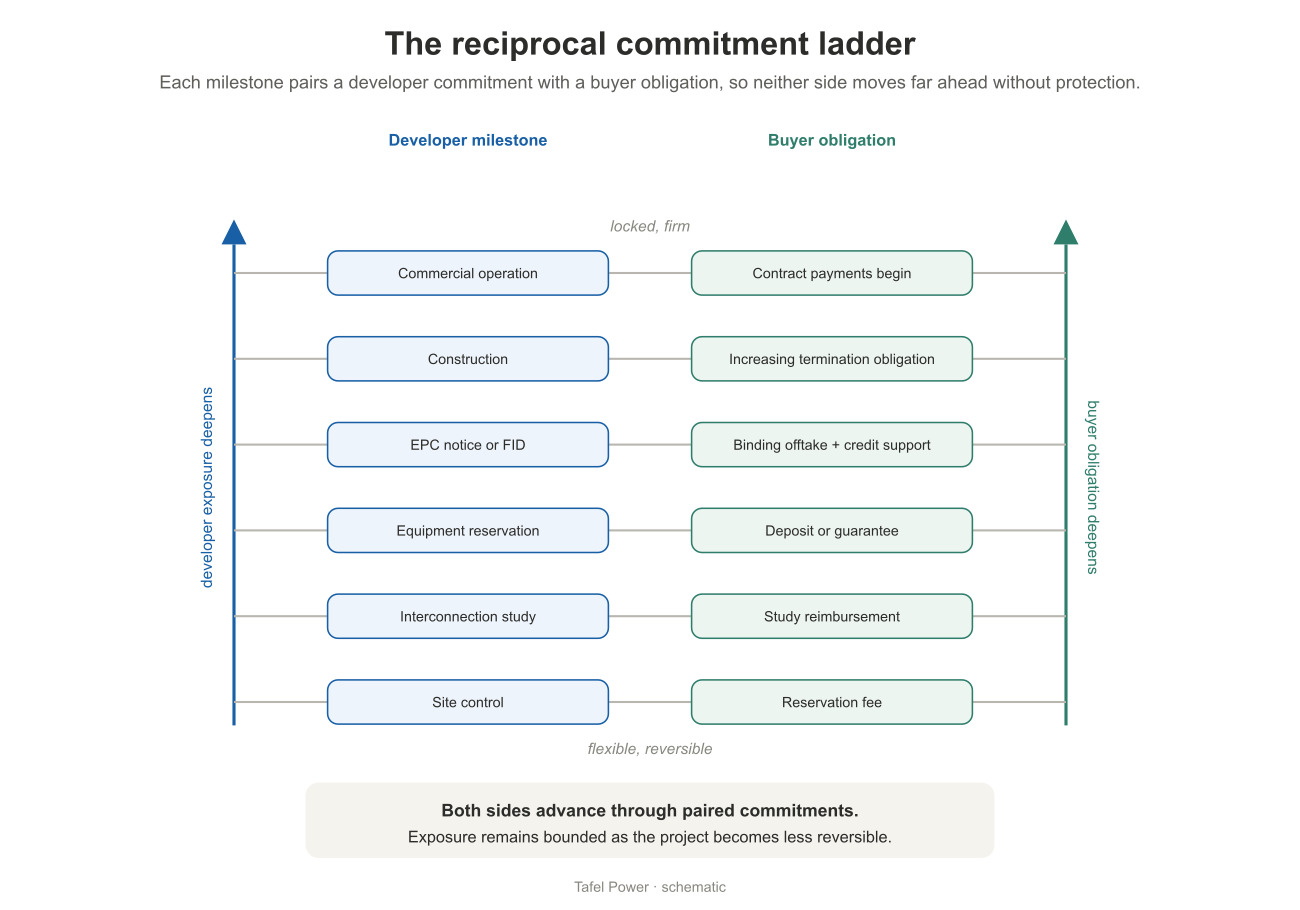
| Milestone | Developer exposure | Buyer obligation | Calibration basis |
|---|---|---|---|
| Site control | Site and diligence cost | Reservation fee | Recoverable development cost |
| Interconnection study | Study cost and queue exposure | Study reimbursement | Actual study liability |
| Equipment reservation | Cancellation liability | Deposit or guarantee | Supplier cancellation schedule |
| EPC notice or FID | Contract termination exposure | Binding long-term offtake and credit support | EPC termination liability |
| Construction start | Major capital committed | Increasing termination obligation | Debt and unrecovered capital |
| Commercial operation | Operating asset exposure | Contract payments commence | Contracted capacity and term |
The principle is bounded exposure, not perfect simultaneity, and it does not require equal risk. Each risk should sit with the party best able to control, absorb, hedge, transfer, or price it, so neither party's uncovered exposure grows materially faster than the other's commitment. At every rung, each side's protection is calibrated to the exposure it creates for the other. Early on both sides keep their flexibility, and by the top both are bound. The timing risk does not vanish; it is shared in proportion to what each side has actually committed.
The ladder is not fixed
None of these instruments is new. Deposits, guarantees, milestone payments, take-or-pay, transfer rights, and staged commitments all exist. The systems insight is not the parts but the shape, which is not universal. It bends with supply and demand, so who commits earlier and posts more is set by which side has alternatives and where scarcity sits.
| Market condition | Likely commercial outcome |
|---|---|
| Power scarce, many buyers | Buyer commits earlier, posts more security, accepts stronger termination obligations |
| Power abundant, few buyers | Developer carries more early risk, offers flexibility, lower deposits, easier exit |
| Equipment scarce | Buyer may fund or secure the turbine and equipment exposure |
| Load uncertain | Developer limits capital, stages construction, or requires stronger credit support |
| Multiple credible buyers | Transferability and portfolio matching become easier |
| One dominant buyer | Buyer can demand more optionality and shift more risk to the developer |
Read that table as the negotiation, not a menu. The same ladder can lean toward the buyer or the developer depending on the market it is struck in, which is why a structure that works in a tight power market fails in a soft one.
Three additions that make it hold
Withdrawn demand replaces itself. Let a buyer that no longer needs its position transfer it to another qualified large load rather than walking, subject to developer approval, credit qualification, site and interconnection compatibility, and regulatory constraints. That creates a secondary market for reserved capacity, lowers the developer's stranding risk, and gives the buyer a cleaner exit than default.
Match portfolios, not single deals. One plant to one data center concentrates all the risk on a single pairing. A developer with scale can match a portfolio of generation to a portfolio of loads with different timing, credit, and shape, so a single withdrawal does not strand a whole project.
Read commitment stage on both sides. The ladder only works if you can tell what rung each party is actually on. Score both: generation on turbine, site, interconnection, permits, and financing; load on site, studies, credit, and contract. Match a real stage to a real stage, not a queue total to an announcement.
Operating within the policy loop
The commercial parties cannot make regulators move at project speed. The ladder operates under rules established in advance, while security and cost responsibility can adjust as verified milestones and actual system use emerge. Staged cost allocation, with security up front, charges indexed to measured system burden, and credits when an upgrade later serves others, lets the regulatory leg move roughly in step rather than arriving as a one-time verdict.
The question worth asking of a real deal
This is not a new contract. It is a framework for calibrating reciprocal commitments to market scarcity and project exposure, built from instruments that already exist. The contribution is the reciprocity and the calibration: composing the tools so neither side's uncovered exposure outruns the other's, and sizing each rung to the market the deal is struck in.
So the question is not whether one side moves first. It is how far that side must move, what exposure it creates, and what reciprocal commitment protects it before the next rung. On a real deal, that answer turns on which side has alternatives and which input is scarce.
Methodology
This brief is a design framework, not an empirical claim. The milestone pairings in the table reflect standard project-finance and interconnection practice, from site control and interconnection studies through EPC notice to proceed and commercial operation, and the individual instruments (reservation fees, deposits, guarantees, take-or-pay, transfer rights, coincident-peak charges) are all in common use. The contribution is the reciprocity, sizing each obligation to the exposure each party creates for the other and to the market's scarcity, so both commercial sides and the regulatory leg deepen together. Calibration is deal-specific and outside this framing.
All framing compiled by Tafel Power from public sources, informed by the firm's transaction advisory work in ERCOT and cross-ISO markets.
Questions, corrections or disagreement on any of this are welcome: kris@tafelpower.com
More from Insights
July 19, 2026
Can Entergy Serve the Next Gigawatt?
Why Entergy is one of the few utilities able to build firm power at AI scale, what customers must fund, and how its regulated model compares with merchant ERCOT.
July 15, 2026
Clean Power Earns Nothing Where It Is Used Most
Europe charges importers for the carbon in their products. In the industries that run on electricity, it ignores the carbon in the electricity. That exemption is borrowed from a European subsidy and ends when the subsidy changes, which makes it a drafting problem for anyone signing a fifteen year power contract.