One Coordination Failure, on Two Clocks
The developer and buyer each need evidence created by the other's commitment, while grid rules adapt on a slower clock.
For hyperscalers · For developers · For infra funds · For utilities · systems · large-load · firm-power · cost-allocation · market-design
Kris Narayanan · Tafel Power · July 21, 2026 · 3 min read
Sit in on any large-load power deal and you hear three complaints. The developer says the load is not real. The hyperscaler says the power will not arrive in time. The grid authority says nobody will tell it which projects are genuine. Each sees a different symptom because each occupies a different part of the same system.
They are describing the same failure.
The developer's seat
In a project developed for a specific large load, the developer is often asked to move before the customer's full commitment is in place. Reserve a turbine amid multi-year equipment lead times, enter a multi-year interconnection study, secure a site, start spending. Each step raises sunk cost and narrows the room to change course, and all of it is justified by a customer that has not signed. The scar every developer carries is the strong letter of intent they once treated like a contract, right up until the customer walked.
The buyer's seat
The hyperscaler has the opposite exposure. It needs power on a fixed date. ERCOT is tracking more than 438 GW of large-load requests, nearly 89 percent associated with data centers. That is a cumulative queue across all requested dates, roughly five times the grid's record peak of about 85 GW. It is proposed demand, not confirmed load. A long-term commitment to a project that slips creates real delivery and concentration risk.
The rule that sits over both
The grid authority wants the party that causes grid cost to pay it. But it must set the rule before realized cost causation is fully observable: which loads are real, which plants get built, how the loads will draw. FERC's June 2026 show-cause orders and the ongoing implementation of Texas Senate Bill 6 are shaping those rules now, ahead of the evidence. Unlike the two commercial commitments, the rule is not part of any single deal. It applies across all of them and is revised as outcomes arrive. It is the slower loop over the fast one.
One failure, on two clocks
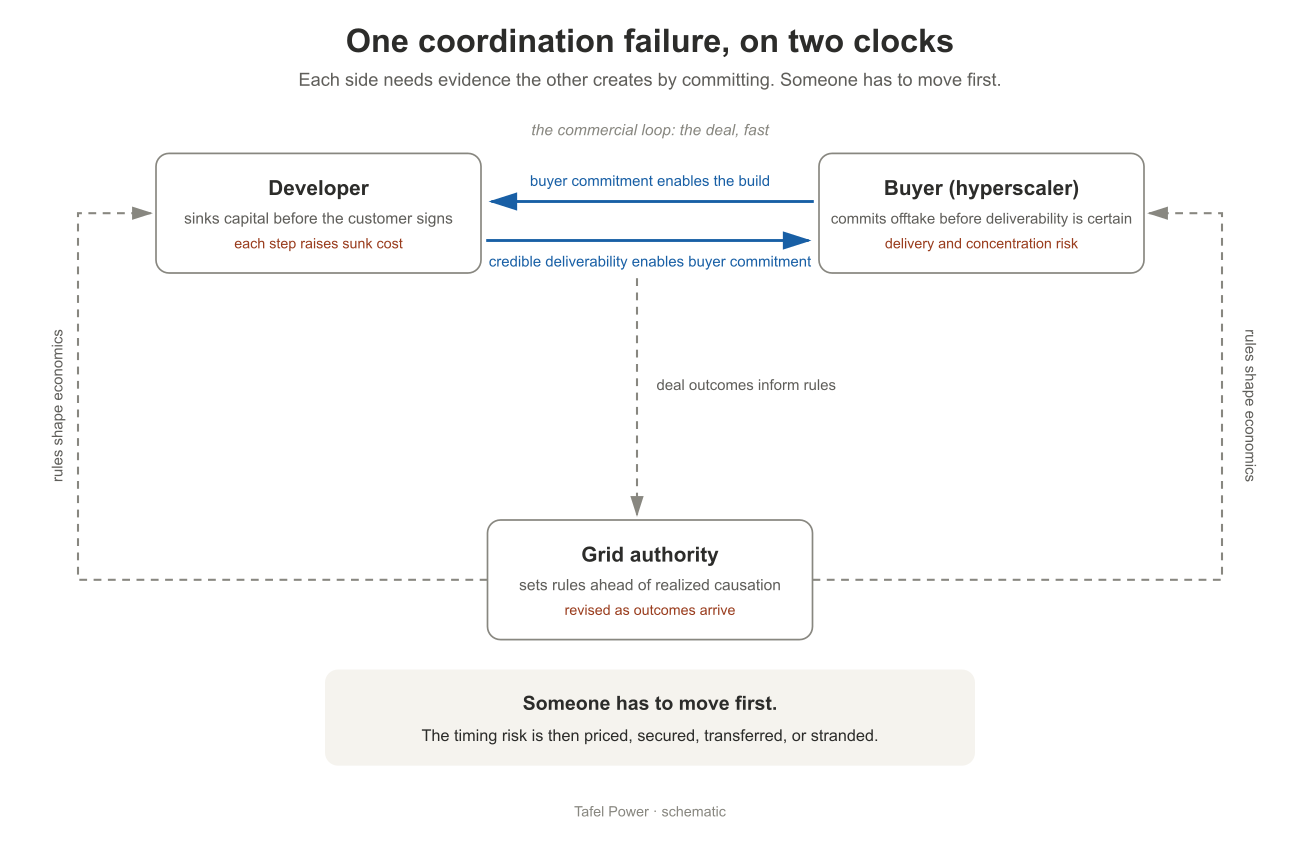
The two commercial parties form a tight loop. Buyer commitment enables developer investment, and credible deliverability enables buyer commitment. Each needs the evidence the other creates by committing, so the deal moves only when one side accepts the risk of going first. Around that sits the slower loop: the grid authority's rules shape the economics both sides face, and the outcomes of the deals that do happen later inform the rules.
Deals still close. When one does, it is because a party accepted the risk of going first, and was paid for it: a higher power price, a nonrefundable deposit, a parent guarantee, a fatter return. Where nobody is paid to carry it, the timing risk does not disappear. It resurfaces as someone's loss: a plant with no load, power that arrives late, or an upgrade that other ratepayers cover.
What to look for
The practical test follows. On any deal, find who is being paid to commit first, and what they get for it: a price premium, security posted, a guarantee, a higher return. If you cannot find it, the risk has not been priced anywhere; it is just deferred until it comes due on someone.
The obstacle is not missing information alone. It is that the information each party needs is created only when another party commits. Because the block is a sequencing problem, the place to intervene is the order and terms in which the commitments deepen, not the accuracy of anyone's forecast. The design fix, a reciprocal commitment ladder in which customer security and developer capital deepen together as milestones are verified, under rules established in advance, is the subject of the next brief.
Methodology
The 438 GW figure and the nearly 89 percent data-center share are ERCOT's cumulative large-load interconnection requests in 2026, reported by ERCOT and trade coverage. The total spans all requested dates and is roughly five times the grid's 85 GW record peak, so it is proposed demand, not confirmed or coincident load, and it is growing quickly. The regulatory references are the June 2026 FERC show-cause orders to the six RTOs and the Texas PUCT's implementation of Senate Bill 6 (Projects 58481 and 58484). Equipment lead times reflect current manufacturer delivery slots. This is a systems framing, and the diagram is a schematic of the commitment structure, not a quantified model.
All framing compiled by Tafel Power from public sources, informed by the firm's transaction advisory work in ERCOT and cross-ISO markets.
Questions, corrections or disagreement on any of this are welcome: kris@tafelpower.com
More from Insights
July 21, 2026
The Reciprocal Commitment Ladder: How Scarcity Determines Who Commits First
The right commitment structure is not universal. It depends on which side has alternatives, which inputs are scarce, and how much unrecoverable exposure each milestone creates.
July 19, 2026
Can Entergy Serve the Next Gigawatt?
Why Entergy is one of the few utilities able to build firm power at AI scale, what customers must fund, and how its regulated model compares with merchant ERCOT.