If You Can't Get a Turbine Until 2029, What Powers the Load?
For hyperscalers, developers, and infra funds: the firm-power options that can actually connect before the gas-turbine backlog clears, ranked by how fast they deliver.
For hyperscalers · For developers · For infra funds · firm-power · turbines · time-to-power · demand-flexibility · data-centers
Kris Narayanan · Tafel Power · July 12, 2026 · 4 min read
The firm-power question has quietly changed from which turbine to get to what you can get without one.
The machine is the bottleneck
Heavy-duty gas turbines come from three makers: GE Vernova, Siemens Energy, and Mitsubishi Power. All three have order books stretching into 2028 and 2029. Siemens is quoting 2029, so a new order is close to a four-year wait. Developers who could not wait rotated to reciprocating engines, smaller gas units you stack in dozens, but so many did that their lead times have lengthened materially too. Caterpillar, a major engine supplier, is booked through 2027, with orders placed early in 2026 delivering in 2028.
For many near-term gas projects, equipment has become a binding constraint alongside fuel, interconnection and transmission. If the load needs power before 2029, the real question is what can deliver without a new turbine at all.
The stack, fastest to slowest
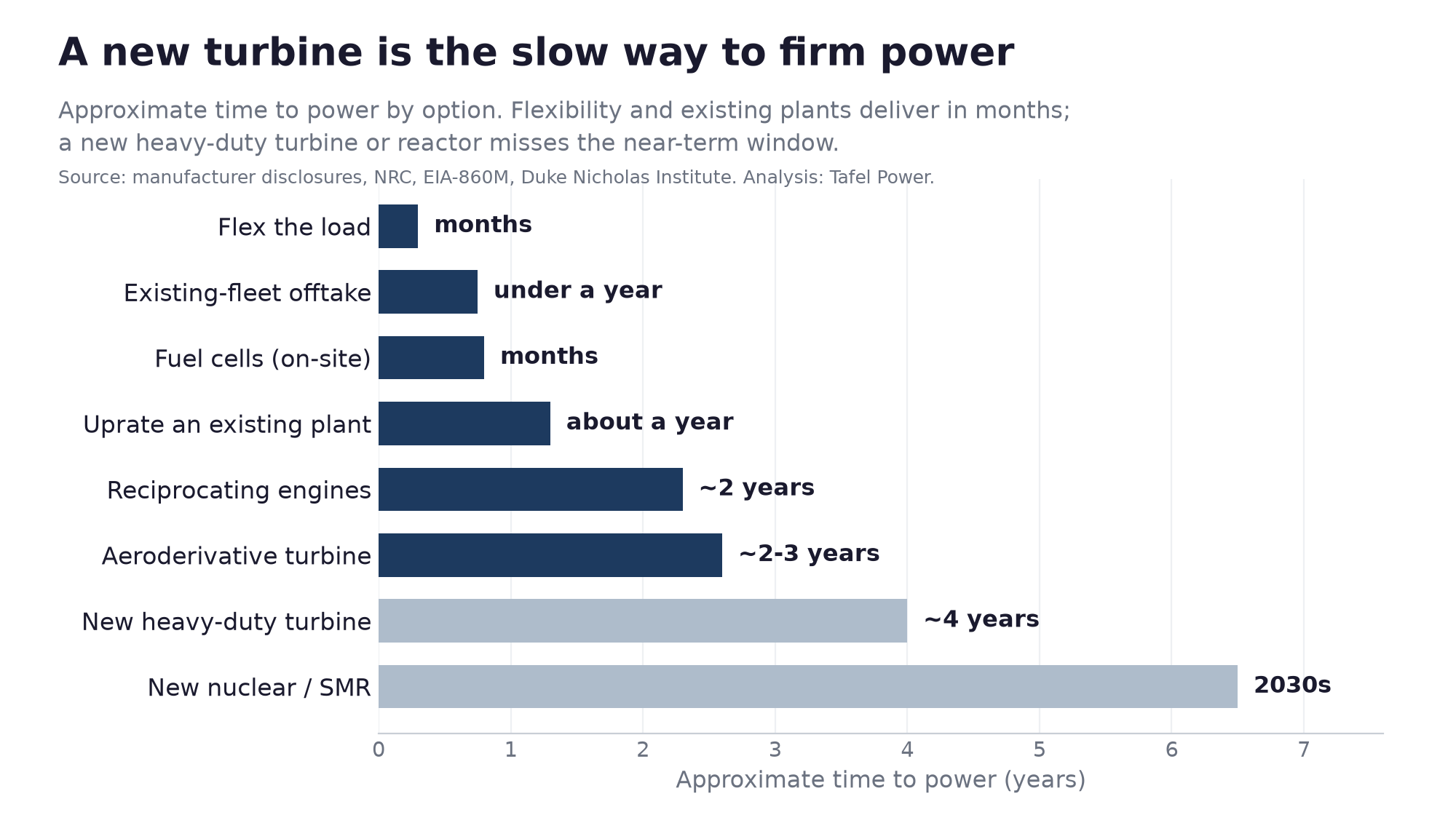
Rank the firm-power options by how fast they connect, and a clear order appears. The fast ones use capacity that already exists or need less of it, and the slow ones are new machines.
Flex the load. Often the fastest option, and potentially the biggest. A data center that can cut its draw for a tiny share of the year unlocks power the grid already has. A Duke University study found that if new loads curtail just a quarter of one percent of their hours, the existing US grid could absorb about 76 GW of new demand, roughly a tenth of the national peak, with no new power plants. By market, allowing a bit more, half a percent of hours, that is about 18 GW of room in PJM and 10 GW in ERCOT. These are modeled, systemwide figures, not capacity guaranteed at any one site; what a specific data center can tap still depends on its local interconnection. Some AI training workloads may fit this model, because they can be paused or shifted for a few hours a year, and both ERCOT and PJM run programs that pay load to be curtailable.
Offtake from the existing fleet. The plants are already built and running. Contracting firm output from an operating gas or nuclear plant is a deal, not a build. This is why proximity to existing generation, rather than a queue position, is where much of the fast money is going.
Uprate what is already there. Squeezing more megawatts out of an existing plant skips new siting and interconnection. Nuclear uprates have added about 8.5 GW to the US grid over the years, and Meta's deal with Vistra includes 433 MW of uprate capacity across three plants. The catch is that the remaining uprate potential is small, a few more gigawatts nationwide, so it is a plant-by-plant lever, not a fix.
Fuel cells. Bloom Energy's on-site cells run on gas and install in months, on the customer's side of the meter, skipping both the turbine and the interconnection queue. The limit is Bloom's own output, roughly a gigawatt or two a year across all customers, so it is fast per site, not unlimited.
Reciprocating engines and aeroderivatives (lighter turbines adapted from jet engines). These were the turbine workaround, and they are faster than a heavy-duty frame, but the rush has pushed their lead times to two years and beyond. They still beat a new frame turbine, just by less than they used to.
A new heavy-duty turbine. About four years. Order it for the plant you want in 2029 and after, but do not build the near-term plan around it. New nuclear and small modular reactors are further out still, into the 2030s.
What this means for the deal
Hyperscaler energy leads. The fastest path to serving the load is often flexibility rather than new generation. Design the load to curtail a little, and the grid you already connect to has far more room than the queue suggests.
Developers. The scarce, valuable position is an existing asset or a firm offtake, not a spot in line for a new turbine.
Infra funds. Value speed to power. An operating plant, an uprate, or a fuel-cell deal that delivers in 2027 is worth more than a turbine slot that delivers in 2029.
The turbine shortage is a real supply problem, but for the next few years, the fix is mostly to use the capacity already on the ground, and to need less new firm capacity in the first place.
This extends What Actually Powers a 24/7 Data Center?, which argued that firm capacity is the scarce layer. This Brief is about how to get it fast.
Methodology
Turbine and engine lead times and orders are from the manufacturers' own disclosures (GE Vernova, Siemens Energy, Mitsubishi Power, Caterpillar, Wartsila, INNIO) and are approximate, so confirm against current order books. Nuclear uprate figures are from the US Nuclear Regulatory Commission, and the Meta and Vistra uprate capacity from the companies' announcements. The curtailment-enabled headroom figures are from Duke University's Nicholas Institute for Energy, Environment, and Sustainability. Existing-fleet capacity is from EIA-860M. The time-to-power ranges are indicative, not guarantees, and vary by project, site, and market. Figures reflect 2025 to 2026 snapshots and may have changed since.
All data compiled by Tafel Power from public sources. Framing informed by the firm's transaction advisory work in ERCOT and cross-ISO markets.
Questions, corrections or disagreement on any of this are welcome: kris@tafelpower.com
More from Insights
July 12, 2026
What Actually Powers a 24/7 Data Center?
For hyperscalers and infrastructure investors: the interconnection queue contains nearly 2 TW of proposed capacity, most of it solar, wind, and storage. The scarce product for a 24/7 load is firm capacity, not annual clean energy.
July 11, 2026
How Much of ERCOT's 69.7 GW Gas Queue Is Credible?
Apply the historical post-IA completion rate to signed gas and a conservative request-to-operation base-rate weight to unsigned gas, and 69.7 GW becomes about 17 GW on a completion-weighted basis.