What Actually Powers a 24/7 Data Center?
For hyperscalers and infrastructure investors: the interconnection queue contains nearly 2 TW of proposed capacity, most of it solar, wind, and storage. The scarce product for a 24/7 load is firm capacity, not annual clean energy.
For hyperscalers · For infra funds · For developers · renewables · firm-power · storage · hyperscalers · interconnection
Kris Narayanan · Tafel Power · July 12, 2026 · 8 min read
Counting capacity is the fastest way to misread the power market, because by that measure nothing is scarce.
Gas is not the only answer. In many US markets it is the most scalable near-term new-build firm option, but the real solution is a portfolio: renewables for energy and carbon goals, storage and flexibility for shaping, and firm capacity for reliability.
The queue is not short of power
Lawrence Berkeley National Laboratory's Queued Up 2026 puts about 2,061 GW of active interconnection requests across the country. The mix is lopsided: solar is 37 percent, storage 36 percent, wind 11 percent, and gas about 12 percent. Nuclear is half of one percent. Gas is also the only category still growing: it rose about 86 percent in the latest cycle even as solar, wind, and storage each shrank, a queue-level signal of the same firm-power scramble this Brief describes.
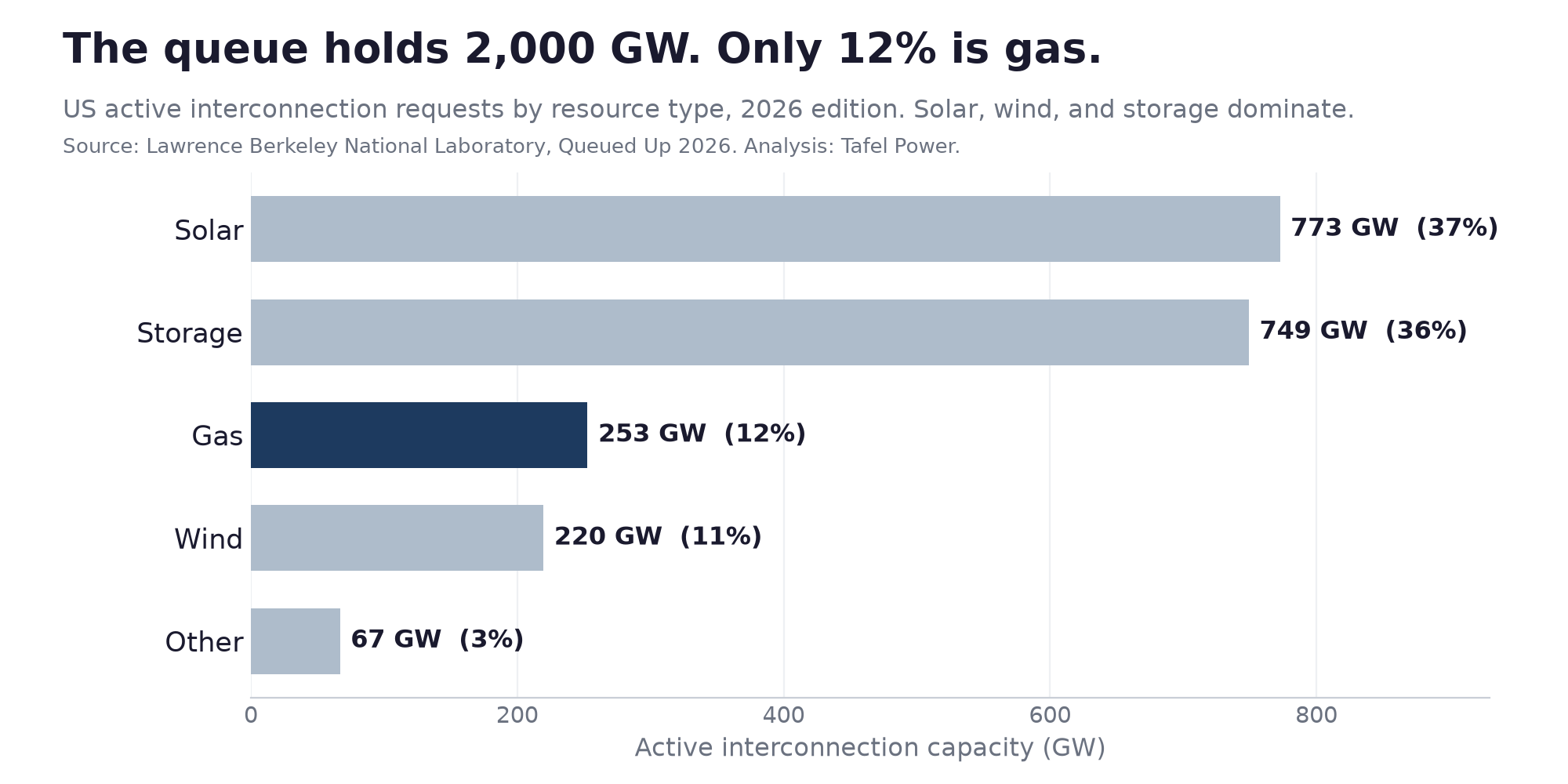
Our own reconciliation of the ERCOT queue shows the same shape from a different source. Of ERCOT's 434 GW gas-and-everything queue, batteries are 163 GW, solar 152 GW, gas 70 GW, and wind 47 GW. Gas is 16 percent. Both datasets agree: the queue is roughly 85 percent variable renewables and storage, and the dispatchable gas slice is about one-eighth.
A queue records requests, not supply. Most queued projects are never built, so it maps development interest rather than power you can contract. That caveat cuts against renewables and gas alike, and it is the same one the earlier Briefs apply to the gas queue.
Capacity is not firmness
A data center runs close to flat, around the clock, at a high load factor. It needs power on demand, every hour. That is a different product from the one the queue is full of.
Solar delivers roughly a quarter to a third of its nameplate over a year; wind delivers 35 to 45 percent in good country. A gigawatt of solar is not a gigawatt of firm power, so the queue overstates firm delivery even more than it overstates gas. Storage, the other 36 percent, does not generate energy at all; it moves energy from one hour to another. A four-hour battery moves solar into the evening and shaves a peak. It cannot carry a load through a still, cloudy stretch of days, and storage sized for a multi-day gap stays limited and costly at that scale. Longer-duration and emerging systems, eight-hour lithium and iron-air designs beginning to deploy, push that boundary out and shrink the firm requirement further, but at today's cost and scale they narrow the firm gap rather than close it.
So the queue can be enormous and still not firm a 24/7 load on its own. Even the gas slice thins out: an earlier Brief filtered ERCOT's 69.7 GW gas queue to an 8.8 GW screened set of merchant projects with signed interconnection agreements and operation requested by 2028. The scarce product is firm power delivered where and when the load needs it, not power in the aggregate.
Solar and wind work, for a different job
They contribute energy and capacity, but they do not provide one-for-one firm supply on their own. For energy and carbon goals, renewables draw deep, competitive interest and are cheaper and quicker to permit than firm capacity, so contracting them is generally more straightforward. It is not free of work: interconnection, basis, congestion, curtailment, and shape all still need diligence. What renewables cannot do alone is guarantee the load is served at 3 a.m. on a windless winter night. That job goes to a firm layer behind them.
What large buyers actually do
The hyperscaler playbook uses renewables for energy, storage and flexibility for shaping, and a firm layer for the hours those cannot cover. That firm layer gets contracted in one of three structures:
Annual matching. Buy enough renewable power to match total yearly consumption, and draw firmness from the grid. This is the most common approach: low-cost energy and an annual emissions-matching framework, with reliability left to the system. It does not, by itself, put a firm electron behind the load at every hour.
24/7 carbon-free energy. Google (by 2030) and Microsoft aim to match consumption hour by hour with a portfolio of solar, wind, storage, and firm-clean sources. This is harder and more expensive because hourly matching forces you to buy firm-clean output at a premium exactly where it is scarcest. Microsoft's 20-year agreement with Constellation to restart Three Mile Island Unit 1, the 835 MW Crane Clean Energy Center, targeted for 2027, is that move: firm, carbon-free output from an existing asset to match its data-center load, without waiting in the queue.
Firm the load directly. Where speed decides the deal, buyers contract firm capacity now: gas on the grid or behind the meter, the existing fleet, or proximity to an existing firm asset. Amazon acquired the data-center campus next to Talen's Susquehanna nuclear plant, then revised the arrangement toward a front-of-the-meter structure, which shows both the value of proximity to firm generation and the regulatory complexity of pairing a large load directly with a plant. The same logic, firm power from an existing asset rather than a queue position, drives behind-the-meter gas where nuclear is not available. Behind-the-meter gas is fast but not simple. It carries a permitting load: air permits for reciprocating engines, tightest in ozone non-attainment areas, an unresolved FERC question on co-locating large loads with generation, and gas-lateral capacity. The speed premium comes with the risk of curtailment or being pushed front-of-the-meter.
Firm options, near to long term
In most US markets, gas is the most scalable near-term new-build firm option, which is why it dominates the firm-power conversation despite being a small share of the queue. It is not the only source of firmness, and often not the first answer. For many buyers the existing dispatchable fleet, reached through offtake, an uprate, or a capacity contract, is the fastest and cheapest firm supply, ahead of any new build. Existing nuclear, hydro, and thermal fleets, utility capacity, demand flexibility, and well-structured storage portfolios all contribute, and what counts as firm and how you buy it differs by market: capacity markets price and accredit it in PJM, NYISO, and ISO-NE, energy-only ERCOT leaves it to bilateral contracts, and utility resource plans govern much of the Southeast and West. Storage shrinks how much firm capacity a load needs but does not replace it.
Which firm option you can actually get is decided by equipment lead times, not just fuel. New heavy-duty gas turbines come from three makers, GE Vernova, Siemens Energy, and Mitsubishi Power, which build most of the world's large units, and their order books extend through 2028 and into 2029. Siemens Energy is quoting 2029, Mitsubishi will not deliver a new order before 2028, and GE Vernova has repriced and rationed its slots. A turbine ordered now is close to a four-year wait, so the turbine, not the fuel, often gates a 2027 or 2028 build. That backlog pushes many buyers to smaller, faster machines: reciprocating gas engines stacked in dozens, and aeroderivative turbines adapted from jet engines. Both connect sooner than a heavy-duty frame, but the rush has stretched even their lead times toward two years. A companion Brief ranks these against the rest of the firm stack by time-to-power. Fuel cells are the faster on-site route, with a ceiling of their own. Bloom Energy's solid-oxide cells run on natural gas, install behind the meter in months, and sidestep both the turbine queue and the interconnection queue; Oracle took its first unit in about 55 days. The limit is Bloom's own output, roughly 1 GW a year and expanding toward 2 GW in 2026. The headline commitments, up to 2.8 GW for Oracle and 1 GW for AEP, are multi-year frameworks that already exceed a year of Bloom's total production, so fuel cells are fast per site but not an unlimited spigot. The premium per megawatt-hour buys speed on a first tranche rather than scale.
Firm-clean supply is already ramping, not just a 2030s story. Google buys 115 MW of geothermal from Fervo for its Nevada data centers, and Meta has signed geothermal supply with Sage Geosystems; both are early but no longer hypothetical. Nuclear and small modular reactors are the larger firm-clean build, but on a 2030s timeline, and hydro is firm and clean where it already exists, mostly the Pacific Northwest.
The queue holds plenty of clean-energy interest. Firm clean energy is the part that is slow to build, which is why gas remains the near-term bridge.
What this changes for the deal
Nameplate misleads twice. Once because most of the queue is variable capacity that does not firm a load, and again because even the gas slice is mostly unsigned and not near-term. In ERCOT, 69.7 GW of gas nameplate becomes an 8.8 GW screened set that is signed, near-term, and merchant.
Hyperscaler energy leads. Treat renewable procurement as the more standardized and competitive layer, and concentrate diligence on the firm layer, which determines your time-to-power and your price.
Infra funds. Value firm and firm-clean capacity, not renewable megawatts. Solar and storage draw deep interest and are priced accordingly; a firm or firm-clean position is the scarce asset with pricing power.
Developers. A firm position, gas today, geothermal or nuclear later, can command a substantial premium where it resolves a binding time-to-power or reliability constraint that a renewable one does not.
For the firm layer specifically, the earlier Briefs are the procurement guide: the 69.7 GW to 8.8 GW filter, the counterparty concentration inside that screened set, and the turbine slot that gates 2027 and 2028 delivery. This Brief argues firm capacity is the scarce resource; those walk through how to contract it.
This is one of a four-Brief series on the firm-power decision: how much capacity is credible, what powers a 24/7 data center, who controls the screened merchant set, and where the load should sit.
Methodology
National queue mix is from Lawrence Berkeley National Laboratory, Queued Up 2026, active interconnection capacity by resource type for 2025 (about 2,061 GW total). Berkeley Lab's own data show most queued capacity is never built, so queue volume is development interest, not commercially available supply. The ERCOT mix is reconciled from the ERCOT June 2026 GIS Report against an archived snapshot of that source: total queue 434 GW, of which batteries 162.6 GW, solar 151.6 GW, gas 69.7 GW, and wind 47.1 GW. Capacity factors are standard published ranges. The firm-power deal examples are drawn from the companies' own public announcements and SEC filings. Figures reflect 2025 to 2026 snapshots and may have changed since.
All data compiled by Tafel Power from public sources. Framing informed by the firm's transaction advisory work in ERCOT and cross-ISO markets.
Questions, corrections or disagreement on any of this are welcome: kris@tafelpower.com
More from Insights
July 11, 2026
How Much of ERCOT's 69.7 GW Gas Queue Is Credible?
Apply the historical post-IA completion rate to signed gas and a conservative request-to-operation base-rate weight to unsigned gas, and 69.7 GW becomes about 17 GW on a completion-weighted basis.
July 10, 2026
The Second-Largest Signed, Near-Term Gas Queue Is in the Plains
For data centers willing to look past the marquee markets: SPP holds more signed, near-term gas than PJM and MISO combined, mostly in Oklahoma and the Texas Panhandle.