How a Data Center Gas Plant Gets Paid
A gas plant outlasts the data center contract that pays for it. What it costs depends mostly on whose money builds it.
For developers · For infra funds · For utilities · For hyperscalers · project-economics · capital · large-load · gas · data-centers
Kris Narayanan · Tafel Power · September 25, 2026 · 15 min read
A gas plant lasts thirty years or more. The data center that needs it usually signs for seven to twenty. Who holds the plant in the years after the contract sets what the money costs, and the cost of the money sets most of the price.
A tolling agreement prices the plant in three charges. They are a capacity payment owed every month, a strike price per MWh when it runs, and a charge each time it starts. The strike and the start charge pass through to the buyer. The capacity payment is what someone has to guarantee for years.
Capacity payment ($/kW-month) = (build cost / multiple + fixed O&M) / 12       owed every month
Strike price ($/MWh)          = heat rate x delivered gas + variable O&M        owed per MWh
Start charge ($/start)        = major maintenance per start                     owed per start
Fixed O&M is what it costs to keep the plant ready. Variable O&M is consumables, plus major maintenance where the turbine maker charges it by running hours. Where it charges by starts, it becomes the start charge. The heat rate is how much gas the plant burns per MWh, and the buyer pays for the gas and its transport either way, which is why the strike passes through.
The price is set mostly by whose money builds the plant
The multiple is the lever. It is how many years of earnings the money pays for the plant. Turned over, it is the share of the build cost that has to come back each year. Williams priced its first Ohio data center gas project on a 10-year, "primarily fixed-price" contract and states a "build multiple for the project" of "approximately 5x EBITDA." TransAlta agreed to buy two new Colorado peaking plants on 25- and 30-year tolls for US$1.0 billion including debt, about 12.5 times their earnings.
| Who funds, on what terms | Share of build cost back each year | Return on the whole project, before debt |
|---|---|---|
| Williams, first Ohio project, 10-year contract (5x, stated) | 20% | about 15% |
| Same return if the contract ran 25 years (what-if) | 15.6% | about 15% |
| TransAlta Colorado acquisition, 25- and 30-year tolls (about 12.5x, calculated) | 8% | about 6.6% |
Both returns are for the whole project, before debt. TransAlta financed three quarters of the price with assumed project debt and expects free cash flow of about US$33 million a year on its US$250 million of equity, about 13 percent by its own measure.
The share of build cost is what each multiple means. The returns assume the plant is worth nothing after the contract; if it is still worth 25 per 100 of build cost, the 10-year developer needs 18.7 a year rather than 19.9 for the same 15 percent. That makes 15 percent a floor for a developer that keeps the plant: if it is still worth half to two thirds of its cost after year ten, the return is about 18 to 19 percent.
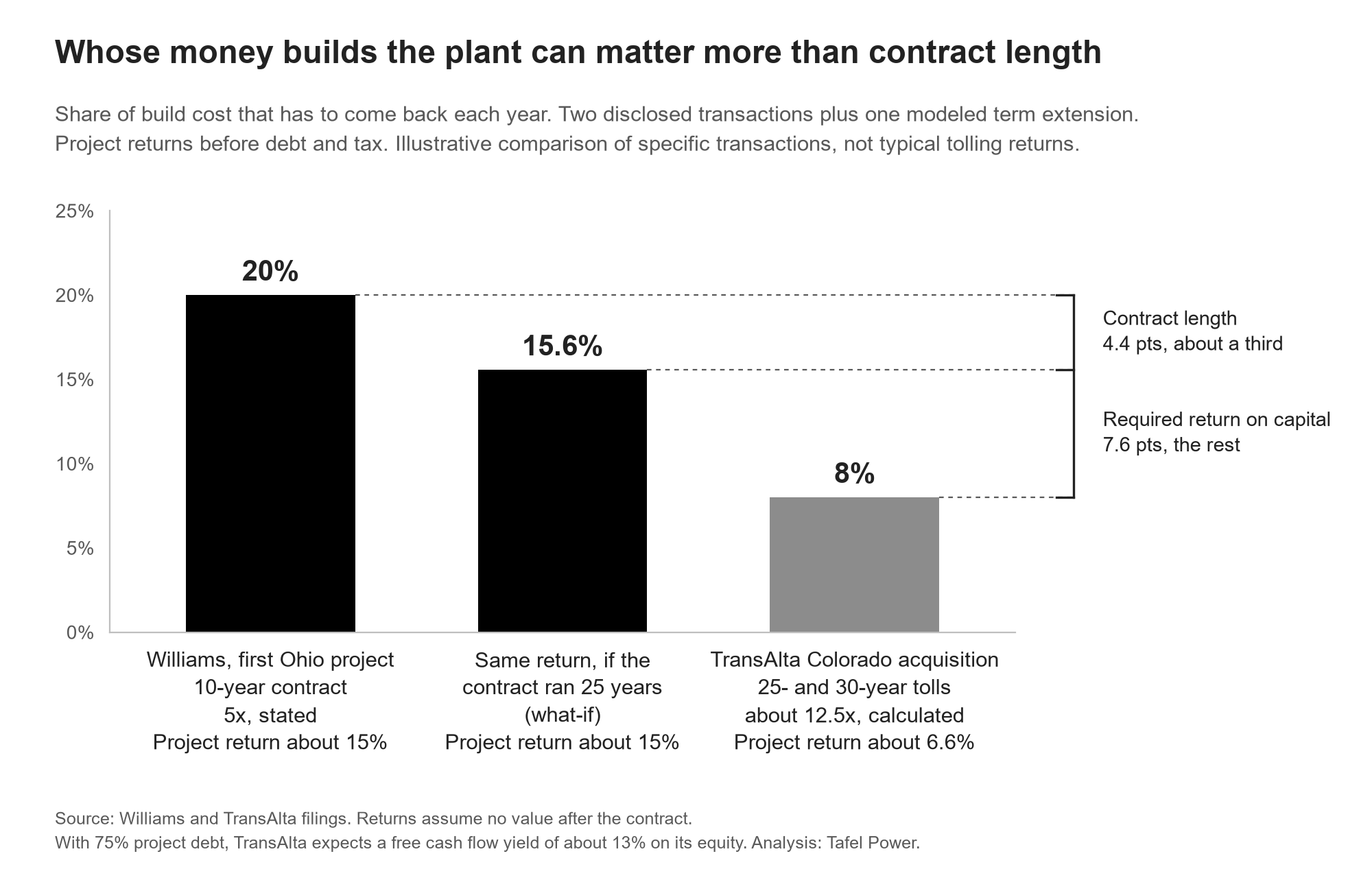
Stretching the contract from 10 years to 25 closes a little over a third of the gap. The rest is the return the money needs. A developer carrying the build and the risk of finding the next customer prices the project for at least 15 percent, and keeps the plant after the contract. An investor buying a finished, contracted plant takes about 6 to 7. A regulated utility's money sits nearer the investor's, and the utility has it before the plant exists.
The cheapest money is a regulated utility's, because a commission sets its return and every customer backs it
A utility puts the plant in rate base, and all of its customers pay for it over its life, as set out in How a Utility Gets Paid. Entergy Louisiana is building three gas plants tied to Meta's Richland Parish campus as "system resources for all ELL customers." Entergy says Meta's agreement runs 15 years and that Meta "will fund the full cost of the utility infrastructure required to interconnect and serve" the data center. Under the settlement, Meta's upfront contributions cover the transmission built for it, and the plants go into rate base as system resources; Entergy expects Meta's contributions and the revenue under its agreement to cover the cost of serving it. Entergy's own projection is that Meta's contributions will save its other customers about $650 million over the agreement. The settlement also plans for renewal: Entergy will assess how Meta's decision affects "the need for the Otherwise Needed Generators," four plants it had planned for 2041 to 2044. If Meta does not renew, the plants built for it could do the job of plants Entergy would otherwise have to build. The public record does not put figures on the end of the term, as is usual for a negotiated contract, so the table below estimates them.
When the contract ends, the plant is still worth something
A fifteen year old plant that the system still needs can be worth about its book value or more, unless new build gets cheaper. At year fifteen, on a 30 to 40 year book life, half to five eighths of a plant's cost is still on the books. What it is worth then depends mostly on what a new one costs. Per 100 of build cost, modeled with the assumptions in the method rather than a price forecast. Book value is the cost not yet depreciated. Worth to a system that needs it is the replacement cost of the plant's remaining years. Worth if sold uses NRG's 2025 purchase at 50 percent of new build replacement cost, capped at the worth in use:
| Contract ends | Book value if depreciated evenly | Worth to a system that needs it | Worth if sold |
|---|---|---|---|
| Year 15 | 50 to 62 | 43 to 84 | 43 to 67 |
| Year 20 | 33 to 50 | 27 to 74 | 27 to 74 |
TransAlta's deck calls its price, about US$3,145 per kW by our arithmetic, "Below the cost of new build gas-fired peakers." If new build keeps rising 2 percent a year after inflation, a plant the system needs is worth more than its book value. If new build gets cheaper and the plant is no longer needed, up to about a fifth of its original cost is at risk.
Wisconsin writes this into its tariff. We Energies' bespoke terms for its very large customer run for at least the plant's depreciable life, and a customer that leaves pays the remaining book value unless, with the commission's approval, the plant can be repurposed for other customers. Unless the plant is repurposed, the customer that asked for it covers its cost. Outside a regulated utility there are no captive customers to hold those years, so the developer relies on renewal, another buyer or the wholesale market.
Outside a utility, developers fit the deal inside the contract
Outside a utility, the contract carries most of the plant, and what is left depends on where else it can sell. Of the 31 gas plants that public filings tie to data center load, 3 sit in an organized wholesale market, though regulated deals are also the easiest to find. Most of the rest are islanded or served by a utility, so the contract, not a market, pays for them. The turbines that will serve xAI at Southaven, Mississippi are a seven-year rental, with fuel supplied by the customer.
Williams shows the developer path from end to end. In March 2025 it agreed to invest about $1.6 billion in two plants and a pipeline for its first Ohio project, Socrates, on a 10-year, "primarily fixed-price" contract "with an option for the customer to extend," at a build multiple of about 5x: 20 per 100 of build cost a year, about 15 percent with nothing assumed after year ten. The customer backs the earliest money: long-lead equipment is "backed by reimbursement from the customer if the equipment order is canceled." The plant is "an islanded behind-the-meter facility," in the siting board staff's words. In July 2026 Williams sold 49 percent of five of its power projects, Socrates among them, to a partner led by Blackstone, which funds 59 percent of the capital for a capped target return of 6.35 percent and can be bought out between years seven and fourteen. The first of the two plants was running in late July 2026.
So the 15 percent is the project's return, not Williams' own. A partner funding most of the capital for a capped return leaves Williams more of each year's earnings on less of its own money, and Williams' deck says the structure "significantly improves WMB project economics." Williams also keeps the plant after the contract, whose value rests on the customer renewing. The structure that gets the plant built layers capped capital under a contracted project return.
Once a utility ring-fences a plant, the two cases have the same shape. The data center pays for the plant inside its commitment, and someone else keeps what is left. Over ten years, per 100 of build cost, a data center pays a developer at 5x about 200, against about 168 to 180 on Wisconsin-style terms. The difference is the price of the money, and it buys two things. The first is time: Williams' first plant ran about 17 months after it was announced, with no grid queue, while Entergy Louisiana's first plants for Meta, approved in August 2025, come into service in 2028 and 2029. The second is a shorter commitment: ten years with an option to extend, against ring-fenced utility terms that run for the plant's whole life.
What the plants going ahead have in common
Each plant going ahead has an answer for the years after the contract.
- A shared utility (Louisiana, Mississippi, Georgia): the plant stays in rate base for all customers.
- A ring-fenced utility (Wisconsin, Indiana): the data center pays for the plant, or its book value if it leaves.
- A developer with a partner (Williams in Ohio): the developer keeps the plant, and its value after the contract rests on the customer renewing.
- A rental (Southaven): the equipment owner gets the turbines back. Its loan, the one project loan among the 31, is mostly repaid inside the rental.
Most of these terms are negotiated privately. Of the 31 plants, the term is public for 18, who carries the gas price for 15, and a dollar figure on any fixed payment or backstop for 6.
What this changes for anyone pricing one of these plants
Three things follow from the evidence.
- The source of the money moves the capacity payment more than the term does. A developer at 5x and an investor at 12.5x are 12 points of build cost a year apart, and stretching the contract closes only about a third of that.
- The years after the contract are part of the price, whether or not the contract names them. Ring-fenced utility terms put them on the data center, shared rate base puts them on all customers, and a developer carries them on its own balance sheet.
- Whether the plant can sell anywhere else decides what those years are worth. An islanded plant's value rests on one renewal. A grid-connected plant has the market to fall back on, and What 15 Percent Takes on a Data Center Gas Plant prices how much of those years the market can pay for.
The contract ends in year fifteen. Who holds year sixteen?
Method
The full table, with every term, source and multiple, is in Data Center Gas Plants: The Record. It covers 31 gas plants, turbines or engines, that a regulator's order, an SEC filing, a permit or the company's own statement ties to data center load in the United States, as of September 2026. Five further candidates were dropped because their filings tie them to load growth, large loads in general or plant retirements, not to data centers. Each plant is grouped by its physical connection and its regulator: regulated and shared across all customers, regulated and ring-fenced to the data center, utility-served outside an organized market, organized market, or not connected to the grid. Every cell the second pass reached was checked against the primary document by a separate reviewer, and the table marks the cells it did not reach. Where a term comes from a party's filing or a settlement rather than a regulator's finding, the table says so.
The 31 plants split into 11 in shared utility rate base, 5 ring-fenced to the data center by a regulated utility, 1 served by a utility outside an organized market, 3 in an organized market and 11 not connected to the grid. The selection favors regulated plants, because regulated deals are filed publicly and many private ones are not. That is one reason only 3 of 31 sit in an organized market, and the count should be read that way.
Multiples are as each buyer or developer stated them, on the earnings year they named, and are not
averaged. Returns are unlevered and before tax: the rate at which paying the build cost and
receiving 1 / multiple of it each year for the term, with nothing after, breaks even. EBITDA is
already net of operating costs, so nothing further is deducted. The script is
fifteen_percent_paths.py. The 12.5 times for TransAlta is our computation from its stated price and earnings. The
US$3,145 per kW is also ours, from the US$1.0 billion price, which includes assumed debt, and 318
MW. The returns in the first table assume the plant is worth nothing after the term, and use
multiple = 1 / capital recovery factor. The investor's return is 6.6 percent over the 27-year
weighted average contract life TransAlta states, and 6.2 to 6.9 percent over 25 to 30 years. That makes 15 percent a floor for the developer. Williams keeps the plants, so if a
plant is still worth half to two thirds of its cost after year ten, the return is about 18 to 19
percent.
The utility's allowed return is built from its parts. How a Utility Gets Paid found allowed equity earnings of 3.94 to 5.46 cents per dollar of rate base across nineteen utilities. Grossed up for the 21 percent federal income tax, that is about 5.0 to 6.9 cents before tax. Interest on the debt share of rate base adds about 2 to 2.5 cents, assuming debt is half of rate base at a 4 to 5 percent cost. That gives about 7.0 to 9.4 percent before tax, well below the developer's 15. The comparison uses 8 to 9, the upper part of that range, which is conservative: a lower allowed return would make the utility cheaper still.
The end-of-contract values are modeled, not observed (plant_tail_value.py). Book life of 30, 35
or 40 years, straight-line depreciation, and a real change in new build cost of minus 1, zero or
plus 2 percent a year. Worth to a system that needs the plant is the replacement cost of its
remaining years. Worth if sold uses the ratio NRG stated for its 2025 purchase of existing plants,
50 percent of new build replacement cost, capped at the plant's worth in use, since a buyer will not
pay more than that. NRG's fleet was of mixed ages, so the ratio is a rough anchor that fits year
fifteen best. By year twenty the cap binds in every case, which is why the last two columns of that
row are the same. Upfront customer contributions are ignored, which overstates the book value left.
The developer and utility comparison is also modeled. The developer case is 5x, so 20 per 100 of build cost a year for ten years. The utility case uses straight-line depreciation over 30 to 40 years, an allowed return of 8 to 9 percent before tax on the opening book value each year, and an exit payment equal to the remaining book value, as Wisconsin's terms set it. The exit at year ten is our assumption: Wisconsin's bespoke term runs at least the plant's depreciable life.
Sources
Where a term comes from a settlement, a staff report or a party's filing rather than a regulator's own finding, it is labeled that way here and in the text. Every other plant and figure in the 31-plant count is sourced in Data Center Gas Plants: The Record.
Contract structure.
- Puget Sound Energy, 2020 All-Source RFP, Exhibit F, Prototype Natural Gas Tolling Agreement Term Sheet, Washington UTC Docket 200414 (party filing): the monthly capacity payment, variable charge and start charge, and the buyer's responsibility for gas and its transport.
Multiples.
- Williams, Form 8-K, March 3, 2025: "build multiple for the project is approximately 5x EBITDA."
- Williams, Form 10-Q, second quarter 2026: the "primarily fixed-price" 10-year agreement, the late July 2026 in-service date, and the buyout right "between years 7 and 14".
- Williams, Form 8-K of July 13, 2026, Exhibit 99.1 and Exhibit 99.2: the partner's share of capital and its target return.
- TransAlta, free writing prospectus and release, June 3, 2026 and prospectus supplement, June 3, 2026: US$1.0 billion including US$750 million of assumed debt, 318 MW, about US$80 million of adjusted EBITDA, 25- to 30-year tolls with a 27-year weighted average, and "Below the cost of new build gas-fired peakers". The 12.5 times and US$3,145 per kW are our arithmetic from these.
- TransAlta, news release, Form 6-K Exhibit 99.1, June 3, 2026: "Free Cash Flow of approximately US$33 million per year ($45 million)". The prospectus supplement shows an "Expected Free Cash Flow Yield" of 13%, which TransAlta defines as the expected free cash flow divided by "the equity portion of the Acquisition". Both are TransAlta's own measures.
- NRG, Form 8-K Exhibit 99.1, May 12, 2025: "50% of estimated new build replacement cost", the anchor for the sale value in the method.
- How a Utility Gets Paid: allowed equity earnings of 3.94 to 5.46 cents per dollar of rate base, the base of the utility return in the method.
Louisiana.
- Louisiana Public Service Commission, Order U-37425, with the Final Stipulated Settlement Term Sheet, August 2025: "system resources for all ELL customers" and the renewal assessment and "Otherwise Needed Generators". Both are settlement terms the Commission accepted as a whole, not its own findings.
- Entergy, Form 10-K for 2025: funding "through direct financial contributions from the customer and the revenues it expects to earn", termination payments "in the event of early termination", and in-service dates.
- Entergy Louisiana release, December 1, 2025 (company release): the 15-year term, Meta funding "the full cost of the utility infrastructure required to interconnect and serve" the data center, and projected customer savings of about $650 million.
- Entergy Louisiana and Energy Transfer release, November 4, 2025 (company release): firm gas transport in north Louisiana through January 2048.
Wisconsin.
- Public Service Commission of Wisconsin, Docket 6630-TE-113, Final Decision, May 21, 2026 and approved Very Large Customer and Bespoke Resource tariff sheets: the term of at least the depreciable life, costs "including Fuel Costs", and the net book value exit unless the plant can be repurposed with Commission approval.
Plants off the grid.
- Ohio Power Siting Board Staff Report, Case 25-0185-EL-BLN, May 29, 2025 (staff report, a recommendation): "islanded behind-the-meter facility" and the recommended condition against interconnection.
- Solaris Energy Infrastructure, equipment rental agreement, Exhibit 10.4 and Form 10-Q, second quarter 2026: the Southaven rental terms, the customer's fuel, and the non-recourse loan secured by the project's assets.
Tafel Power analyzes publicly available filings, regulatory records and company disclosures. Where the record stops, it models with stated assumptions, not forecasts. It does not provide investment, legal or regulatory advice, and does not use confidential deal information.
Questions, corrections or disagreement on any of this are welcome: kris@tafelpower.com
More from Insights
September 25, 2026
What 15 Percent Takes on a Data Center Gas Plant
On an island, the contract has to repay the plant. Connected to the grid, part of the cost moves to a market that pays well in some years and little in others, and only if the load can step aside.
September 25, 2026
Data Center Gas Plants: The Record
Thirty-one gas plants that public filings tie to data center load, in five groups, read from the orders, the SEC filings, the permits and the company releases. Facts and sources only. The argument is in the brief this supports.