What 15 Percent Takes on a Data Center Gas Plant
On an island, the contract has to repay the plant. Connected to the grid, part of the cost moves to a market that pays well in some years and little in others, and only if the load can step aside.
For developers · For infra funds · For hyperscalers · For utilities · project-economics · capital · gas · data-centers · flexibility
Kris Narayanan · Tafel Power · September 25, 2026 · 7 min read
A data center that can reduce its load in a few hours of the year needs less firm supply and can often connect sooner. SPP's conditional service for large loads, accepted by FERC in June 2026, is built on that: curtailable service for one to seven years while the customer works toward firm service, with expedited interconnection for generation dedicated to the load. What flexibility is worth still depends on what each market's transmission charge measures, as set out in Batteries, Generators, or Demand Response?. Where the load can flex, on-site gas covers the hours it cannot, and the plant can be smaller.
The plant is paid as set out in How a Data Center Gas Plant Gets Paid: a capacity payment every month, a strike price for fuel and running costs when it runs, and a start charge each time it starts. Two very different structures can earn about 15 percent on it. Figures below are per 100 of build cost a year.
On an island, the contract has to repay the plant
An off-grid plant has one possible buyer, the data center next door, so the contract prices in the plant's full cost.
| Contract length | Plant worth nothing after | Worth 25 after | Worth 50 after |
|---|---|---|---|
| 7 years | 24.0 | 21.8 | 19.5 |
| 10 years | 19.9 | 18.7 | 17.5 |
| 15 years | 17.1 | 16.6 | 16.1 |
| 20 years | 16.0 | 15.7 | 15.5 |
Williams states a build multiple of "approximately 5x EBITDA" on a 10-year contract, or 20 a year, almost exactly the 19.9 in the table. Fixed operating cost adds about 0.4 to 0.6 per 100 of build cost a year on top of the 20, at EIA's 12.12 dollars per kW-year for a combined cycle plant. Maintenance that follows running hours sits in the variable charge and passes through with the fuel, and maintenance charged by starts passes through as a start charge. The contract gives "an option for the customer to extend," so the plant's value after year ten depends on renewal.
Connected to the grid, part of the plant's cost moves to the market
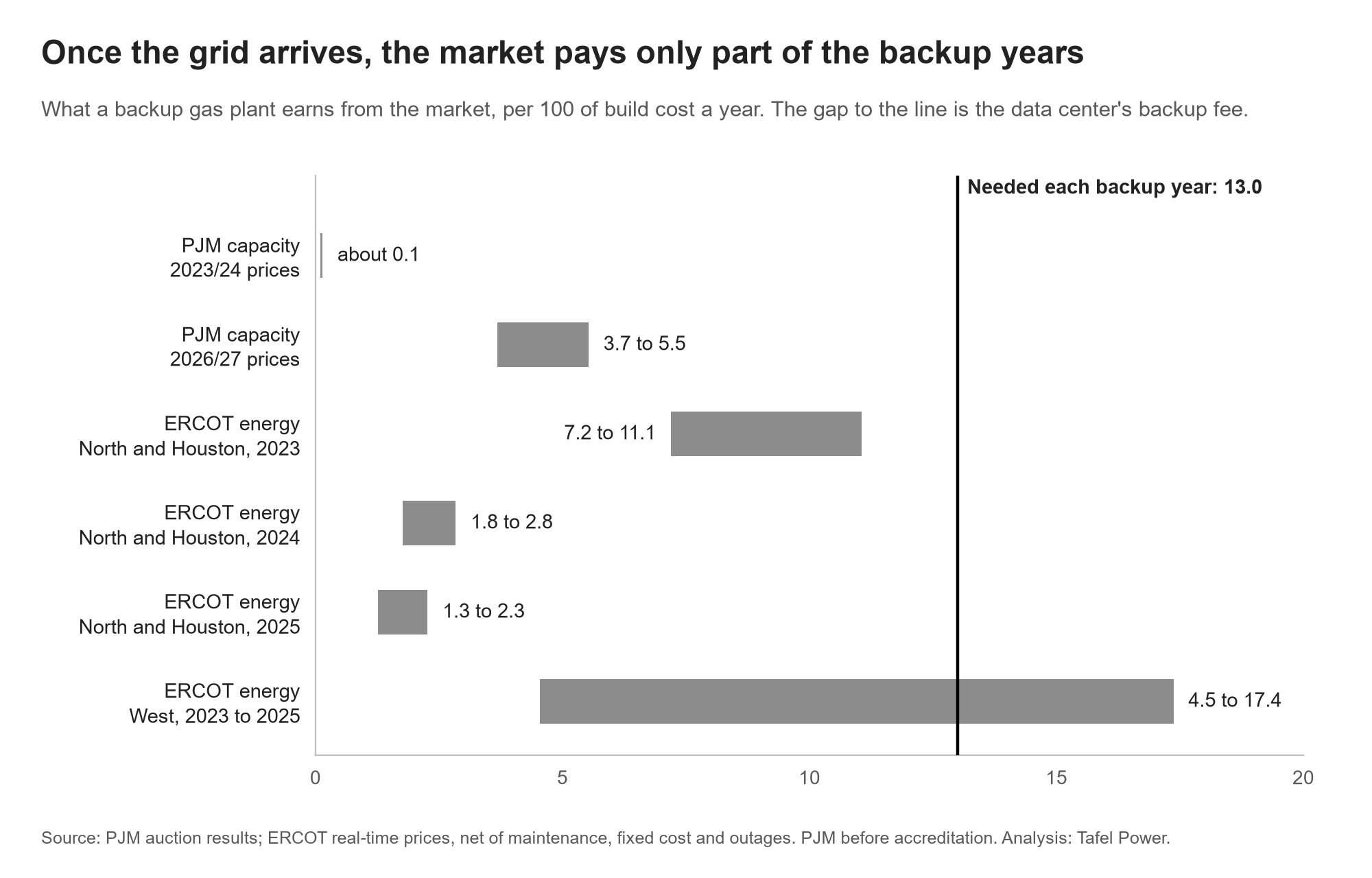
On the second path the plant serves the campus while the grid connection is built, then becomes backup. Its cost continues, and the market pays only part of it. After three years as the main supply at 20 a year, each backup year still needs about 13 to reach 15 percent over 25 years, or about 10.8 if the data center paid 24 a year while the plant was its main supply. How much the market pays depends on which market.
| Market and year | Plant earns from the market | Backup fee still needed |
|---|---|---|
| PJM capacity, 2023/24 prices (a) | about 0.1 | about 12.9 |
| PJM capacity, 2026/27 prices (a) | 3.7 to 5.5 | 7.5 to 9.3 |
| ERCOT energy, North and Houston hubs, 2023 | 7.2 to 11.1 | 1.9 to 5.8 |
| ERCOT energy, North and Houston hubs, 2024 | 1.8 to 2.8 | 10.2 to 11.2 |
| ERCOT energy, North and Houston hubs, 2025 | 1.3 to 2.3 | 10.7 to 11.7 |
| ERCOT energy, West hub, 2023 to 2025, local gas | 4.5 to 17.4 | 0 to 8.5 |
(a) Before accreditation, so an upper bound. All figures are net of maintenance and fixed operating cost; ERCOT figures are also net of forced outages.
PJM's 2026/27 auction cleared at its cap of 329.17 dollars per MW-day, against 34.13 for 2023/24. ERCOT has no capacity auction, so a plant earns only when the real-time price beats its running cost. After maintenance, fixed costs and outages, a peaking plant at the North and Houston hubs earned about 216 to 221 dollars per kW-year in 2023 and 38 to 57 in 2024 and 2025. About 70 percent of the 2023 margin came in its top 100 hours. The West hub earned more because local gas is cheaper there. Both markets swing by several times from year to year, and the backup fee has to cover what the market does not.
On this path maintenance is the cost that grows, because a backup plant starts often. The ERCOT figures charge it the way EIA prices each turbine type:
| Cost | Aeroderivative turbines | Frame H-class turbine |
|---|---|---|
| Heat rate | 9,447 Btu/kWh | 9,142 Btu/kWh |
| Variable O&M | 5.70 $/MWh, including major maintenance by running hours | 1.24 $/MWh, consumables only |
| Start charge | none, maintenance is by hours | 23,100 $ per start, about 55 $ per MW |
| Fixed O&M | 9.56 $/kW-year | 6.87 $/kW-year |
| Starts a year, 2023 to 2025 prices | 800 to 1,200 | 230 to 260 |
| Forced outages | 7.7 percent of margin | 7.7 percent of margin |
The frame unit starts less because a start costs more, so it skips short price spikes. Together, maintenance, fixed cost and outages cut the margin at the North and Houston hubs by about a sixth in 2023 and by a third or more in 2024 and 2025, so they weigh most when the market pays least.
The market pays most in the hours the grid is short, which are also the hours a backup plant would serve the data center. So it pays a backup plant only if the load can step aside. Texas has that condition in a regulator's order, in a different arrangement: a 760 MW data center added behind the grid connection of Freestone Energy Center, an existing 1,099 MW gas plant. The order keeps "all of FREC's available generating capacity" in ERCOT's dispatch, and the data center "fully curtails its consumption" within 30 minutes when ERCOT directs.
Added up, the data center pays for the plant either way. On the island path it pays about 200 per 100 of build cost over ten years, and after that whatever renewal costs. On the backup path it pays about 60 in the first three years and a backup fee after, about 225 to 320 over 25 years in PJM at 2026/27 prices and in ERCOT at 2024 and 2025 prices. These are simple sums, not discounted.
Both structures carry the same need
On an island, the risk is renewal: one customer holds the option. On the grid, the risk is the market: a second buyer, but one whose price swings by several times from year to year and who pays only when the data center can step aside. Either way, someone pays for the years the plant is not the main supply. The return on either structure comes down to who, and on what terms.
Method
All figures are modeled, per 100 of build cost, from fifteen_percent_paths.py. The target return
is 15 percent, the horizon 25 years. Path A solves for the annual charge that recovers the build
cost over the contract, less the present value of the plant's worth afterwards. Path B charges 20
a year while the plant is the main supply, then solves for what each later year needs; at 24 a year
the need falls from 13.0 to 10.8.
ERCOT energy margins are from ercot_backup_margin.py, on ERCOT's 15-minute real-time settlement
point prices for 2023 to 2025 (MIS report 13061). Two plant types are modeled on EIA's AEO2025 cost
cases: four aeroderivative turbines (9,447 Btu/kWh, 5.70 dollars per MWh variable cost including
hours-based major maintenance, 9.56 dollars per kW-year fixed) and one frame H-class turbine (9,142
Btu/kWh, 1.24 dollars per MWh consumables plus 23,100 dollars of major maintenance per start, 6.87
dollars per kW-year fixed). Gas is monthly Henry Hub plus basis: zero at the North and Houston hubs,
minus 2.08 at the West hub, the 2025 figure for West Texas utility plants in EIA-923. The plant runs
in any stretch where price beats its variable cost and skips a stretch that does not cover a start.
Forced outages remove 7.7 percent, NERC's 2024 weighted rate for all conventional generation (the
gas-only figure appears only in a chart). Planned maintenance is assumed outside the high-price
hours, and outages that cluster in stressed hours would cut more.
Capacity prices are PJM Base Residual Auction clearing prices as published by PJM, converted at 365 days to dollars per kW-year, and to per 100 of build cost at an assumed build cost of 2,000 to 3,000 dollars per kW. They are shown on nameplate, before accreditation, less the backup plant's fixed cost of 9.56 dollars per kW-year; a plant accredited below its nameplate earns proportionally less. No energy margin is counted for the backup plant. SPP's conditional service is from FERC's order accepting it (Docket ER26-1323, 5 June 2026). The Williams figures are from its Form 8-K of 3 March 2025 and Form 10-Q for the second quarter of 2026.
Sources
- PJM, 2023/2024 Base Residual Auction Report
- PJM, 2026/2027 Base Residual Auction Report, July 22, 2025
- PJM, Capacity Market (RPM), other auction years
- ERCOT, Historical RTM Load Zone and Hub Prices, MIS report 13061
- NERC, 2025 State of Reliability, Technical Assessment
- EIA, Capital Cost and Performance Characteristics, AEO2025
- Williams, Form 8-K, March 3, 2025
- Williams, Form 10-Q, second quarter 2026
- FERC, order accepting SPP's Conditional High Impact Large Load Service, 195 FERC 61,196, Docket ER26-1323, June 5, 2026.
- Public Utility Commission of Texas, Docket 58872, order of May 2026 (Freestone Energy Center net metering arrangement).
Tafel Power analyzes publicly available filings, regulatory records and company disclosures. Where the record stops, it models with stated assumptions, not forecasts. It does not provide investment, legal or regulatory advice, and does not use confidential deal information.
Questions, corrections or disagreement on any of this are welcome: kris@tafelpower.com
More from Insights
September 25, 2026
Data Center Gas Plants: The Record
Thirty-one gas plants that public filings tie to data center load, in five groups, read from the orders, the SEC filings, the permits and the company releases. Facts and sources only. The argument is in the brief this supports.
September 16, 2026
How a Utility Gets Paid
A regulated utility earns on one equation with three terms, and one of them moves far more than the others. Across nineteen US utilities the allowed rate of return sits in a narrow band while rate base varies by nineteen times even after setting the two smallest aside. So the ranking of who earns most is a rate base ranking, and that decides which structures a utility can say yes to.